Kickers Are People Too
How one man with one leg outscores entire NFL teams, more often than you’d ever believe.
30 min read
On January 15, 2017, in a divisional playoff game at Arrowhead Stadium, the Pittsburgh Steelers beat the Kansas City Chiefs 18-16.
Pittsburgh did not score a single touchdown.
No rushing touchdowns, no passing touchdowns, no fumble recoveries in the end zone. Every point the Steelers put on the board came from the right leg of Chris Boswell. Six field goals. Zero extra points. Eighteen points. In a playoff game.
Boswell alone outscored the entire Kansas City Chiefs roster. One guy, standing 7 yards behind the line of scrimmage, swinging his leg six times, produced more points than a 53-man roster of professional athletes playing in front of 76,000 screaming fans.
This is a story about that. About all the times it’s happened. And about what it tells us about the most misunderstood position in professional sports.
The Lowest Rung
In the hierarchy of NFL glory, kickers sit at the bottom. That’s not an opinion. It’s practically codified into the culture of the sport.
They don’t throw touchdown passes or make diving catches in the end zone. They don’t deliver bone-crushing hits that send the crowd into a frenzy. Most of them weigh less than the average linebacker’s leg. They wear jerseys that somehow always look too clean. In a sport built on violence and the relentless collision of enormous human beings, kickers just… stand there. Wait for the snap. Take a few steps. Swing.
When they succeed, nobody notices. When they fail, it becomes a meme, a career-defining lowlight replayed until the end of time. Scott Norwood. Blair Walsh. Cody Parkey. Roberto Aguayo. The names of missed kicks linger in public memory far longer than the names of kickers who made the ones that mattered.
“Kickers aren’t real football players.” You hear it on talk shows, in locker rooms, all over social media. It’s said with a smirk, sometimes with affection, but always with the understanding that kickers exist in a lesser category. They come in for a few seconds, do their thing, and jog back to the sideline while the real players get back to work.
And yet.
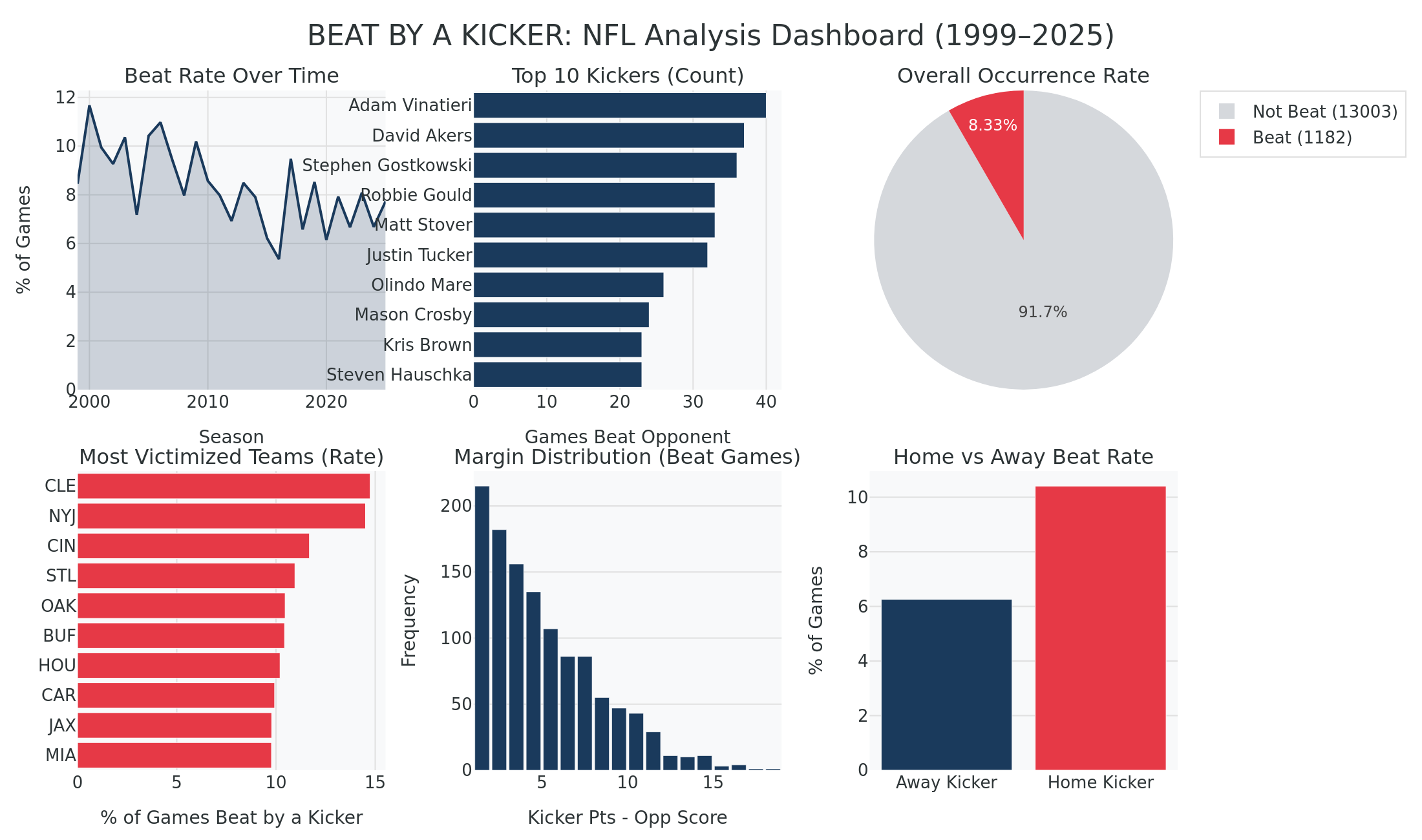
In roughly one out of every twelve NFL games, one of these supposedly lesser athletes, one man with a ball and a goalpost, scores more points than the entire opposing team combined.
Not the offense. Not the special teams unit. One player, doing the thing everybody dismisses as “not real football,” outproducing 53 opponents and their entire coaching staff and game plan.
I dug through 27 seasons of NFL data, every game from 1999 to 2025, to find out how often this actually happens, who does it best, and what it says about football’s most underappreciated position. What I found surprised me at every turn.
The Headline Number
The math is simple. A kicker scores points two ways: field goals (3 points) and extra points (1 point). Add those up for each game, compare the total against the opposing team’s entire score. No adjustments, no advanced metrics, no regression models. Just arithmetic applied to 14,185 kicker-game records across 27 NFL seasons.
Across those 14,185 games from 1999 to 2025:
- 1,182 games (8.3%): the kicker outscored the opponent
- 218 games (1.5%): the kicker tied the opponent’s score
- 12,785 games (90.1%): the opponent scored more
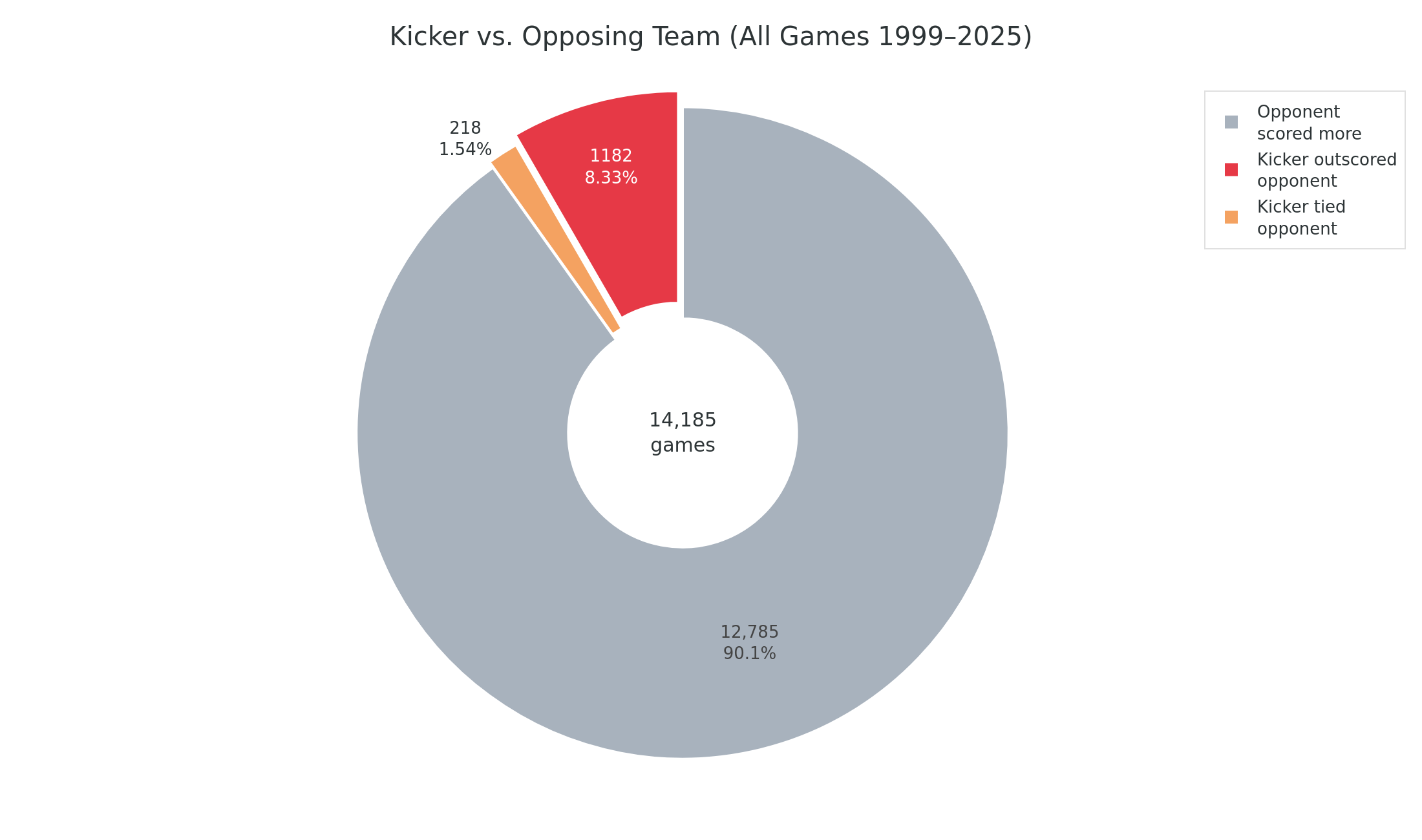
One in twelve. Not a fluke caused by a handful of bad teams in bad weather. Not some artifact of garbage time or meaningless Week 17 games between eliminated teams. This happens consistently, across 27 seasons and thousands of matchups. If you watch an entire Sunday slate of NFL football, there’s a good chance at least one game ended with a kicker having outscored an entire opposing roster.
For perspective: the average kicker scores 6.8 points per game. The average opponent scores 22.0. A three-to-one gap. And yet, nearly 1,200 times, one man bridged it.
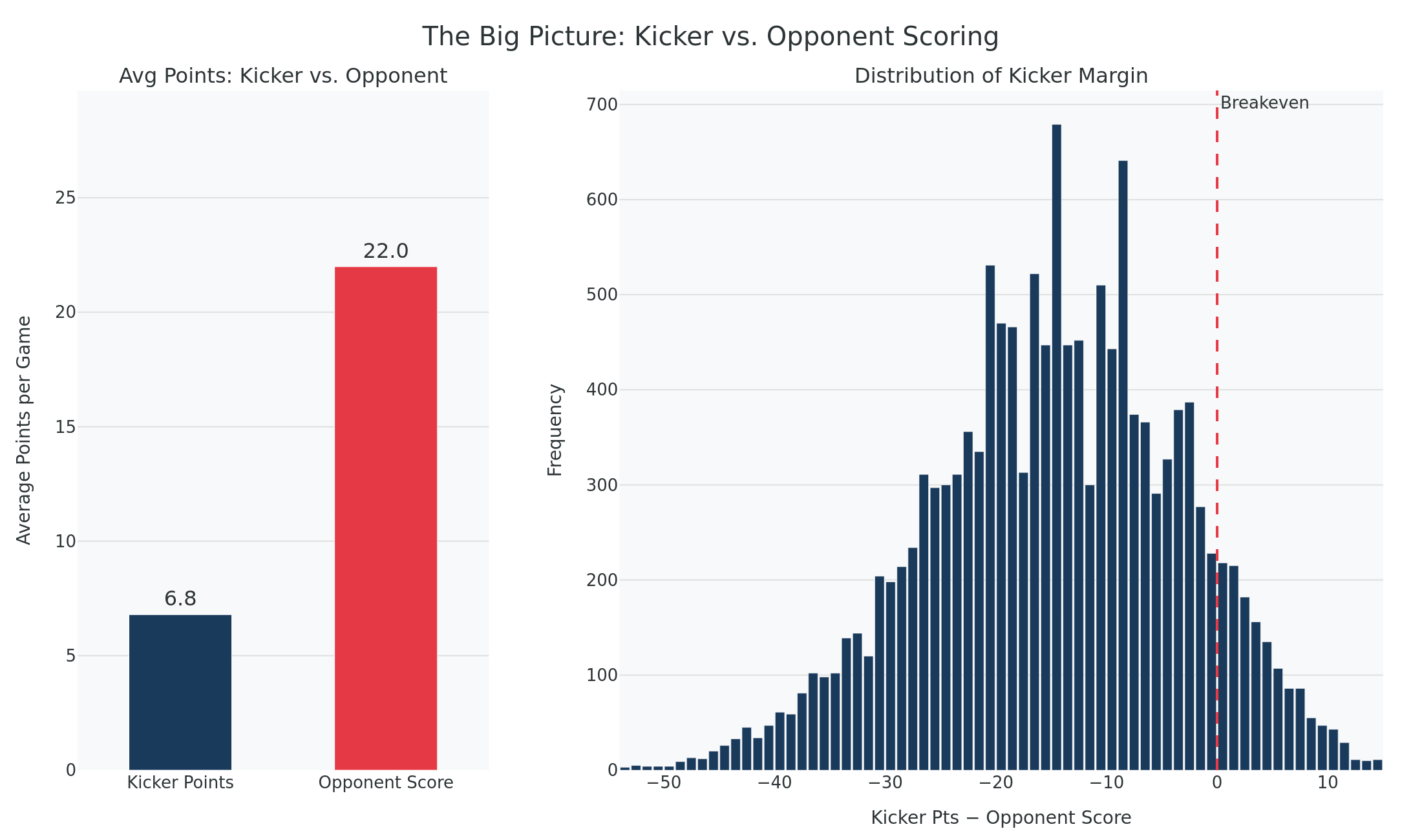
You don’t see this kind of thing in other sports. In baseball, a pitcher doesn’t score runs. In basketball, individual players outscore other individuals all the time, but the team dynamic is completely different. In soccer, a striker might outscore the opponent 1-0, but the margins are tiny.
Football is the only major sport where a single specialist, a player who touches the ball for about 3 seconds per play, can regularly generate more points than an entire opposing franchise. And it happens once every twelve games.
A Fading Art?
The NFL has changed a lot since 1999. The Ty Law Rule. The Brady-Manning era. The passing game explosion. The read-option. Analytics. Rule changes that favor receivers, protect quarterbacks, and have pushed scoring to historic highs. Modern offenses look nothing like their turn-of-the-millennium ancestors.
You’d expect this phenomenon to be dying out. As offenses improve and teams score more freely, it should get progressively harder for one kicker to outscore an entire team.
The data is more complicated than that.
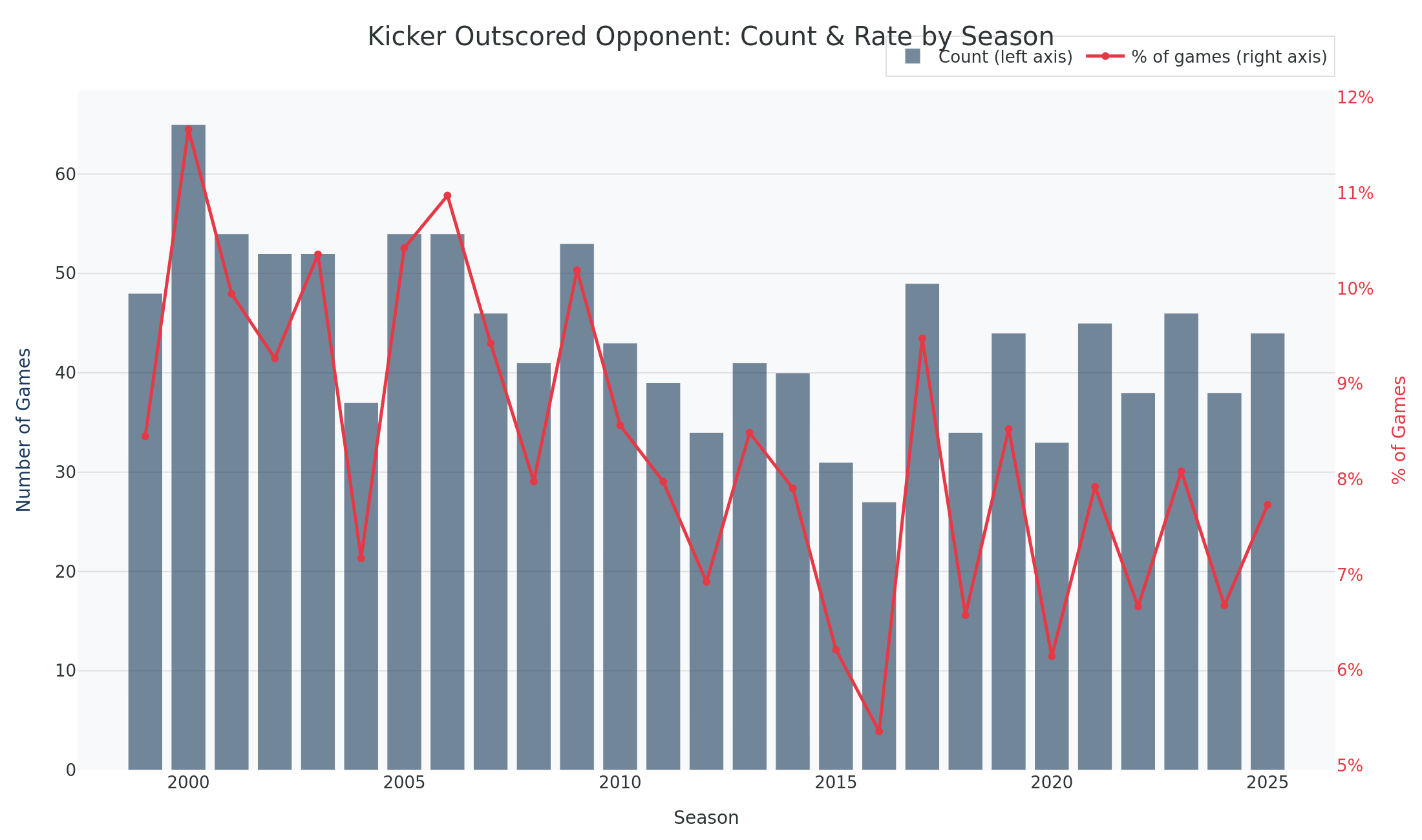
The early 2000s were the golden age. The 2000 season peaked at 11.7%, nearly one in eight games, driven by league-wide offensive ineptitude that made low-scoring games common. (This was the year the Baltimore Ravens won the Super Bowl with a historically dominant defense and an offense so anemic it cycled through three different starting quarterbacks.) The 2016 season hit a low of 5.4%, the only year in the dataset where the rate dipped below 6%.
Recent years have settled into the 6-8% range. It’s faded, but it hasn’t disappeared. Even in an era of record-breaking scoring, kickers still outscore entire teams roughly once every 15 games.
The more interesting trend is hiding in the averages:
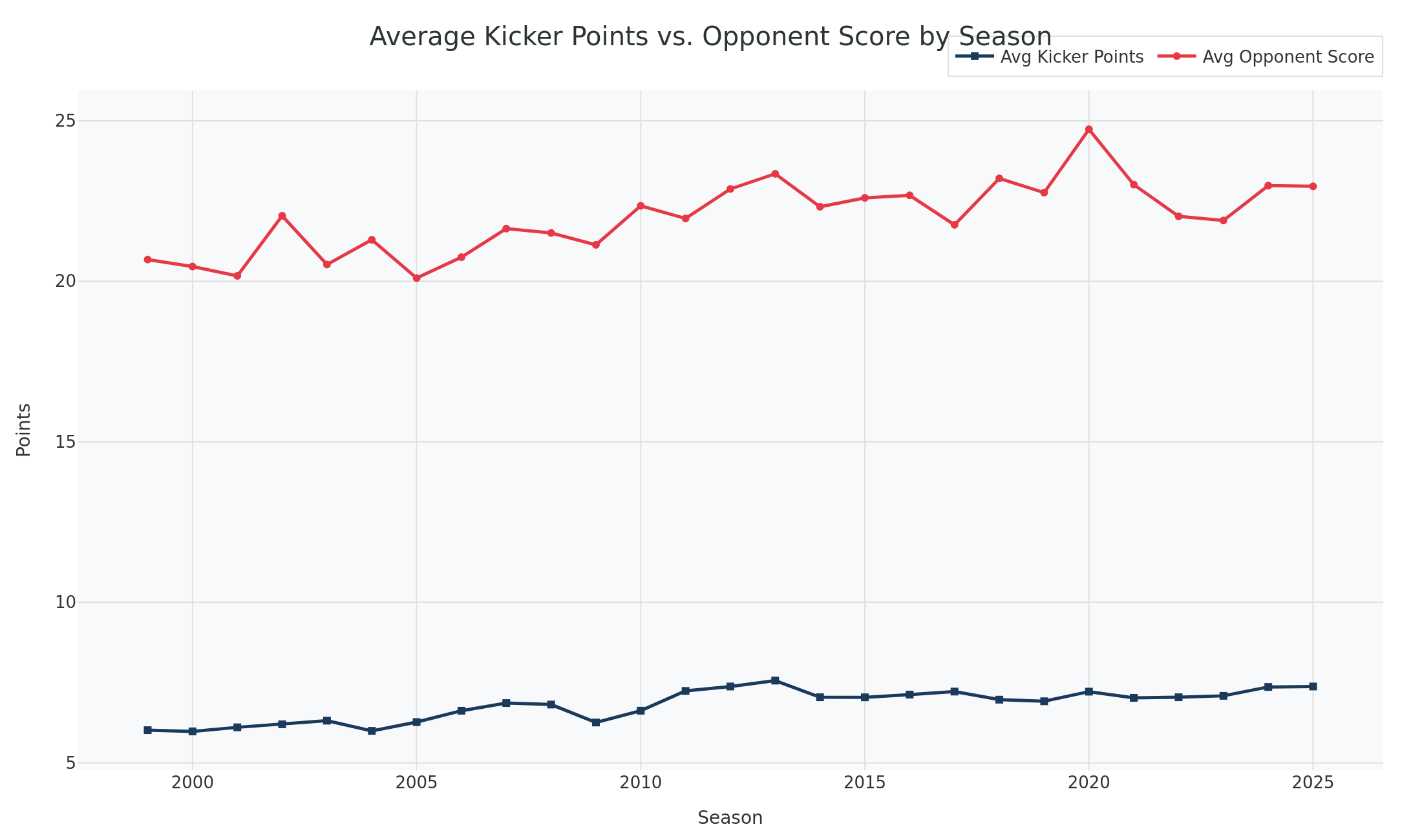
Look at those two lines pulling apart. Average kicker points have barely budged, hovering around 6-7 per game for the entire 27-year window. But average opponent scores have climbed steadily, from about 20 points per game in 1999 to peaks above 23 in recent years.
The kicker’s job hasn’t changed. Everything around him has.
The NFL got faster, more explosive, better at converting opportunities into touchdowns. Kickers kept doing what they’ve always done: standing behind the line, waiting for the snap, swinging their leg. The fact that “beat by a kicker” games still happen at all in the modern NFL says less about offensive futility and more about kicking consistency. The game evolved. The kicker stayed.
The Legends
Not all kickers are created equal. Some have turned outscoring the opponent into a repeatable skill, doing it so consistently and across so many seasons that it becomes a defining, if invisible, feature of their careers.
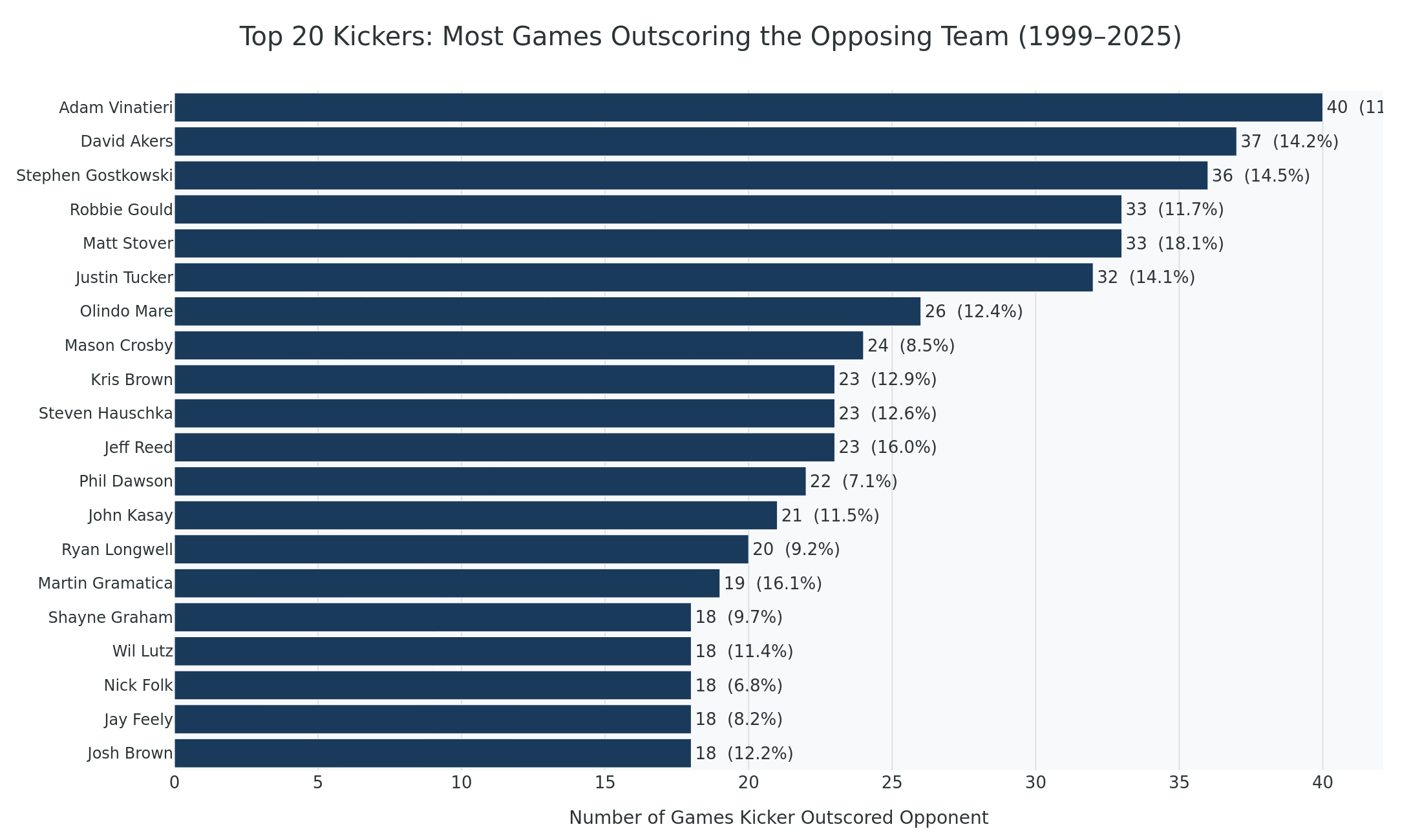
Adam Vinatieri sits at the top: 40 games where he scored more than the entire opposing team. Forty. Across 342 games and 15 seasons, spanning two franchises and three decades, from the early Brady dynasty in New England to the twilight years in Indianapolis. That’s a career within a career. If you only counted his “beat” games, Vinatieri would still have more dominant performances than most kickers have total games.
David Akers is close behind at 37, followed by Stephen Gostkowski at 36, the man who inherited Vinatieri’s job in New England and built his own legacy in the same stadium. Robbie Gould and Matt Stover each sit at 33. Justin Tucker, widely considered the most accurate kicker in NFL history, has 32 and counting.
But raw count rewards longevity. Play enough games and the beats pile up. The sharper question is who does it at the highest rate.
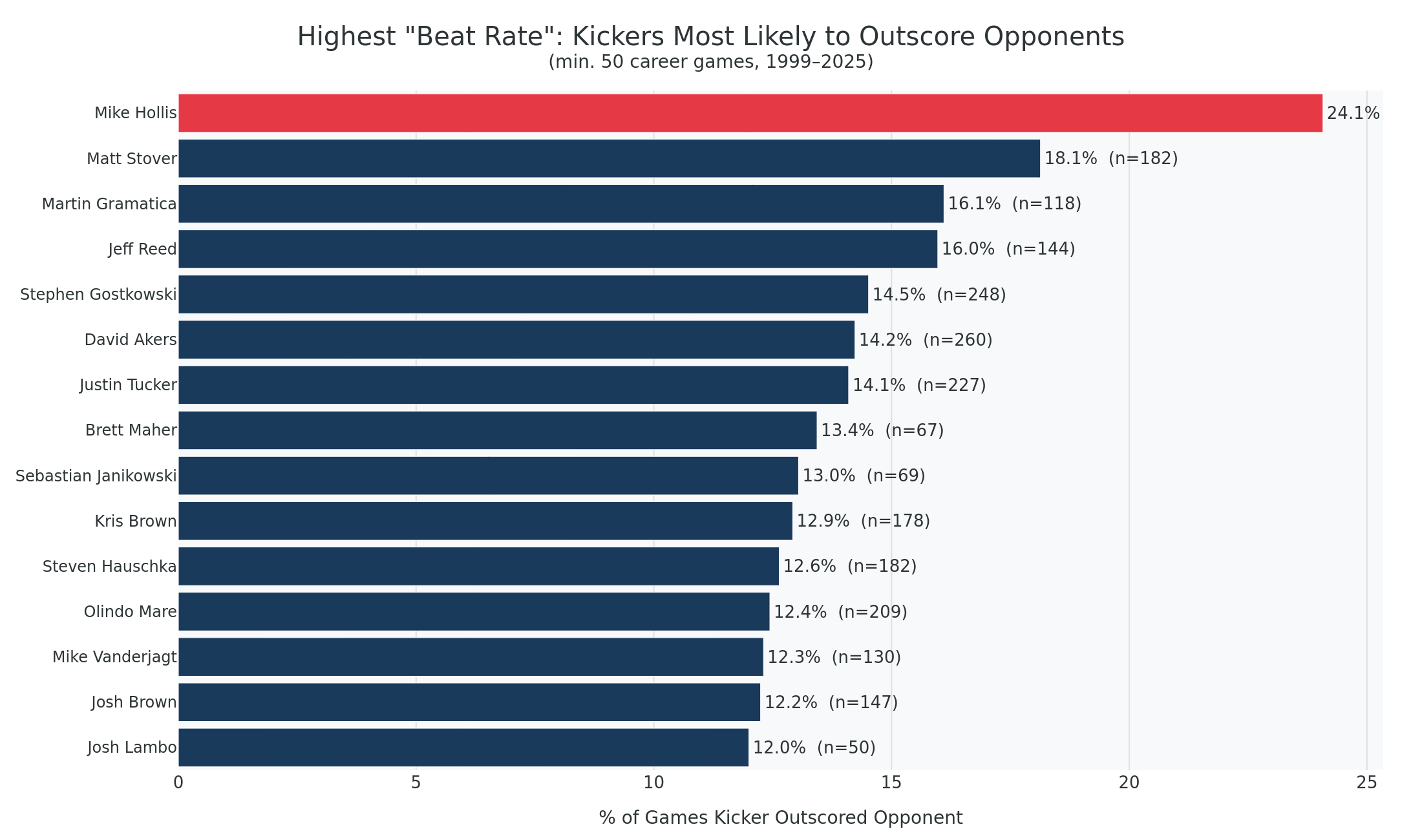
Control for opportunity and a different picture shows up.
Mike Hollis leads at an almost absurd 24.1%: in roughly one out of every four games he played, he personally outscored the entire opposing team. His Jacksonville tenure from 1999-2001 coincided with one of the franchise’s strongest defensive eras, and Hollis reaped the rewards. The sample is smaller (54 games), but the rate is wild.
Matt Stover at 18.1% is the one worth studying. Thirty-three beats in 182 games over 10 seasons, nearly all in a Baltimore Ravens uniform. Stover kicked behind one of the greatest defenses in NFL history, the 2000 Ravens, who surrendered a record-low 165 points in a 16-game season. In that 2000 season alone, Stover outscored the opponent in 10 of his 20 games, a 50% rate that may never be matched. Half the time he took the field, he individually outproduced the entire opposing team. The Ravens defense held opponents so low that Stover, doing his job with a few field goals and extra points, was enough.
Martin Gramatica, Jeff Reed, Stephen Gostkowski, David Akers, Justin Tucker: all above 14%. The true greats show up on both lists, high count and high rate. They didn’t just stick around long enough to accumulate stats. They were dominant while they were there.
Their careers, plotted season by season:
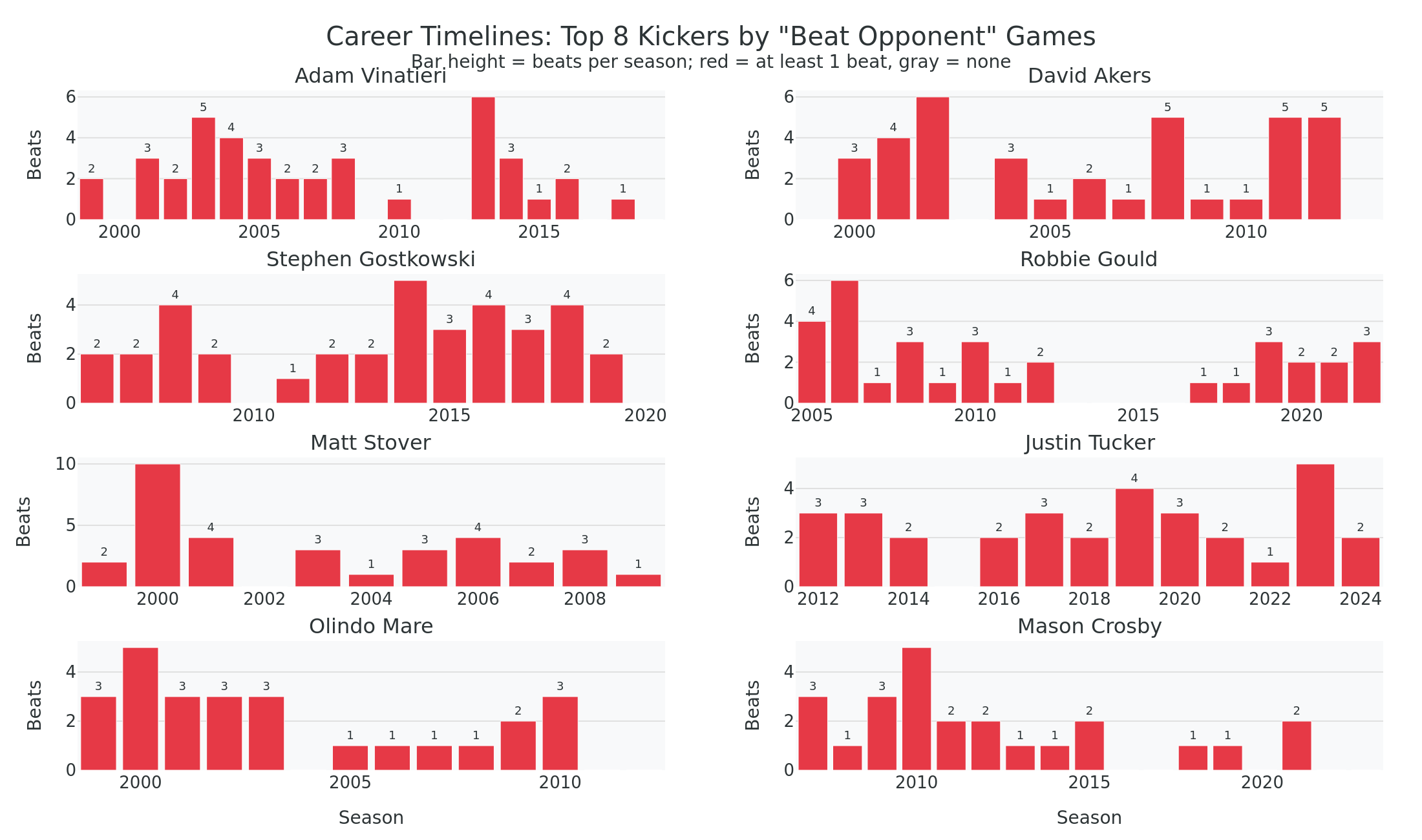
Each bar is a season where the kicker outscored at least one opponent. The careers unfold in different shapes: Vinatieri’s 15-season span dwarfs the competition in length. Stover’s towering 2000 season stands alone. Gostkowski maintained steady dominance throughout the 2010s. Akers peaked in Philadelphia and then faded. Some careers are compressed bursts of dominance packed into a few seasons, then gone.
Each of those seasons contained at least one game where a guy most fans couldn’t pick out of a lineup produced more points than an entire opposing franchise. And then he jogged to the sideline, put on his jacket, and waited to do it again.
Masterpieces
Career totals tell one story. But some individual performances stand on their own, single games where one kicker’s output dwarfed an entire NFL roster’s best effort.
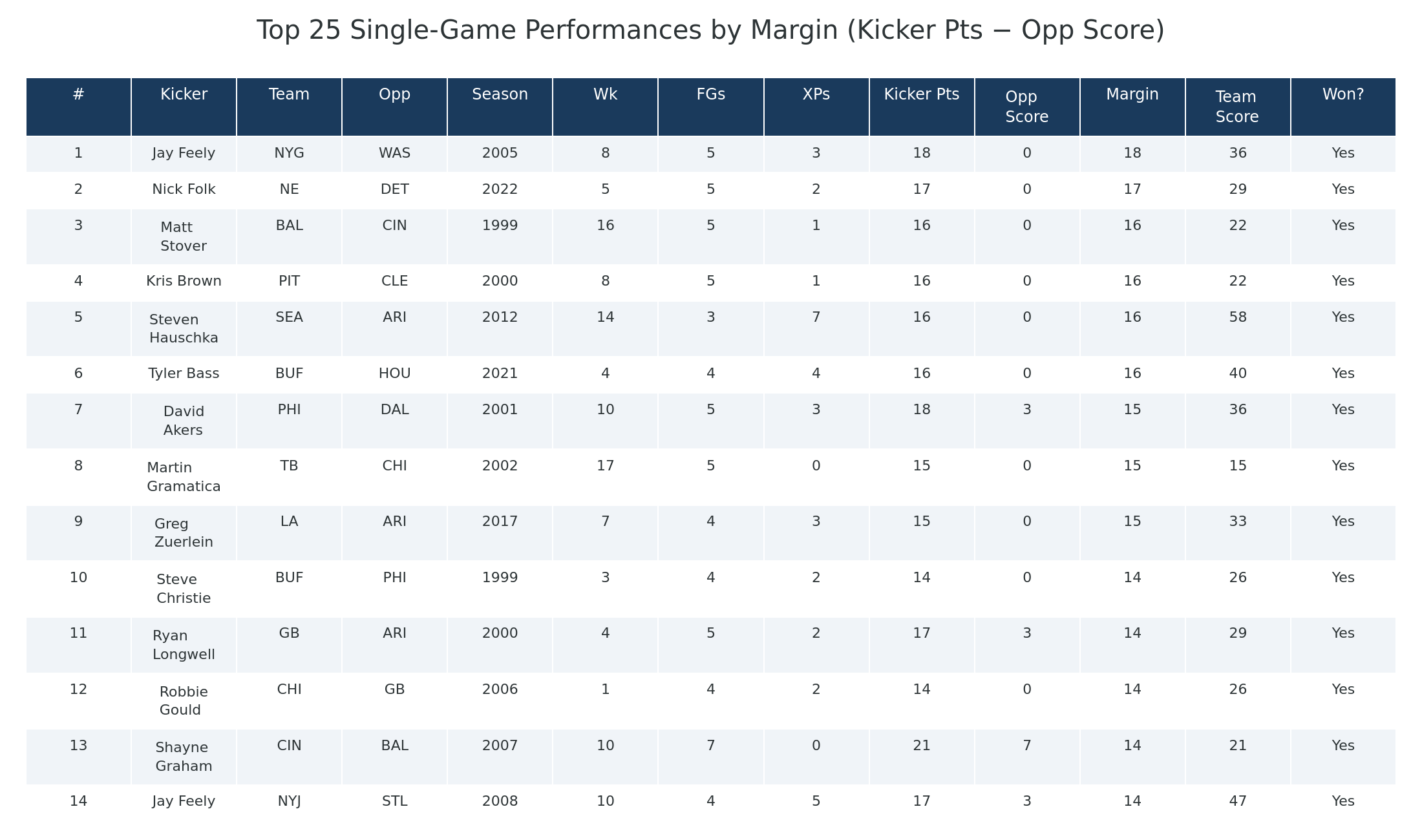
The all-time record belongs to Jay Feely of the New York Giants. On October 30, 2005, in a Week 8 game against Washington, Feely scored 18 points (5 field goals, 3 extra points) while Washington scored zero. Margin: +18. The Giants won 36-0, and even in the context of a blowout, one specialist outscoring the opposition by the equivalent of three touchdowns is absurd.
Nick Folk sits second with 17 points against a shutout Detroit Lions team in 2022. Matt Stover, Kris Brown, Steven Hauschka, and Tyler Bass each posted 16-point margins in games where the opponent scored nothing.
Then there are the performances that feel more impressive because the opponent actually scored. David Akers put up 18 points against Dallas in 2001 (5 field goals, 3 extra points) while the Cowboys managed only 3. A +15 margin against a team that got on the board. Martin Gramatica had a similar game in 2002: Tampa Bay beat Chicago 15-0, with Gramatica going 5-for-5 on field goals and scoring every single point for the Bucs. No touchdowns at all.
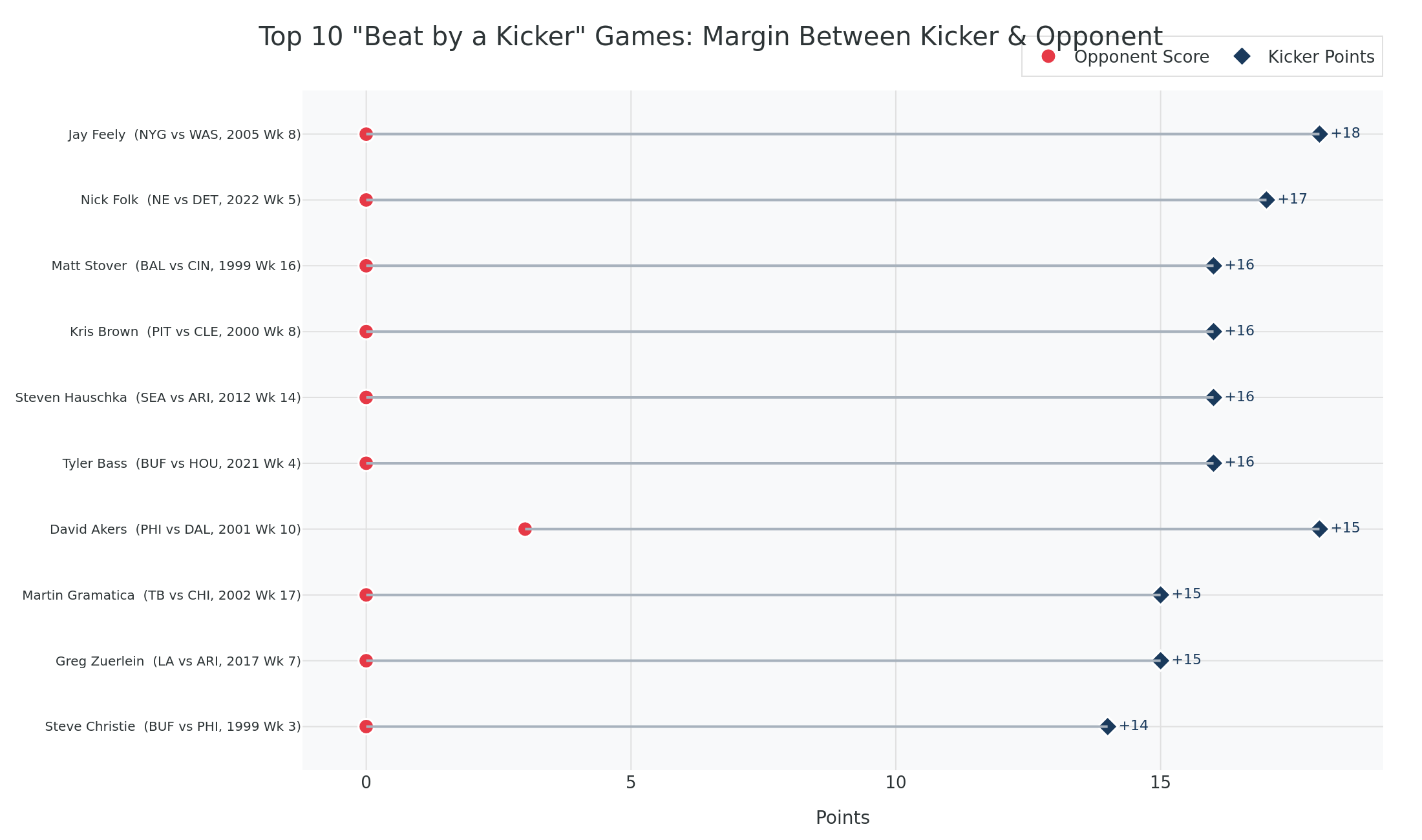
In the most extreme cases, kickers outscored opponents by 15 or more points. You traveled to an NFL stadium. You suited up 53 men. You employed a coaching staff and a front office. You ran an offense, a defense, and special teams. And one guy with one leg outscored you by more than two touchdowns.
The Shayne Graham Game
Some games deserve to be told as stories, not statistics.
On November 11, 2007, the Cincinnati Bengals traveled to M&T Bank Stadium to face the Baltimore Ravens. What followed was one of the most bizarre offensive performances in NFL history.
The Bengals won 21-7.
They did not score a single touchdown.
Every point, all 21, came from the right leg of kicker Shayne Graham. Seven field goals. Zero extra points. No touchdowns, no two-point conversions, no safeties. The Bengals ran plays, moved the chains, drove into field goal range over and over, and then handed the ball to Graham. Seven times he lined up. Seven times he converted. Seven three-pointers, adding up to 21, enough to beat a team that actually did score a touchdown.
Only two games in the entire dataset feature a “one-man show” kicker reaching 21 points. Graham’s performance wasn’t just dominant; it was structurally unique. A team built its entire scoring output around 7 field goals and won an NFL game. The kicker wasn’t carrying the offense. He was the offense.
Three Points at a Time
Graham’s game is the extreme, but it points to a larger truth about how these performances get built. A kicker’s arsenal has just two weapons: field goals (3 points each) and extra points (1 point each). In dominant games, which one does the heavy lifting?
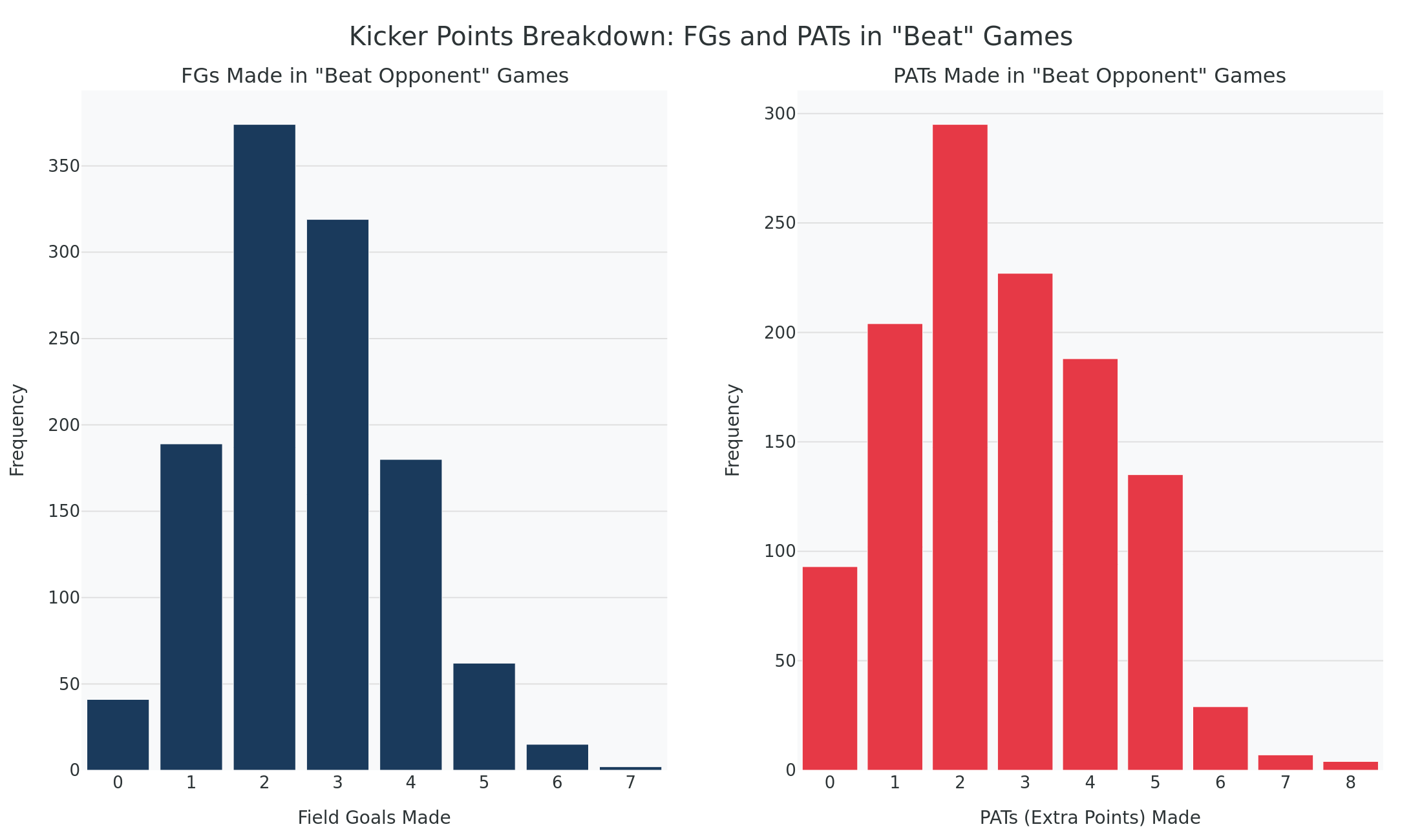
Field goals, and it’s not close. Most “beat” games feature kickers hitting 2-4 field goals with a couple of extra points on top. The field goal is the kicker’s real play, the one where the points belong entirely to him, where no touchdown scorer gets the credit. Extra points are a bonus for someone else’s work. Field goals are his.
The most common kicker point total in these games clusters around 9-12 points, enough to top a struggling offense but hardly a superhuman effort. A kicker doesn’t need the game of his life to outscore an opponent. He just needs to be reliable while the opposing offense sputters.
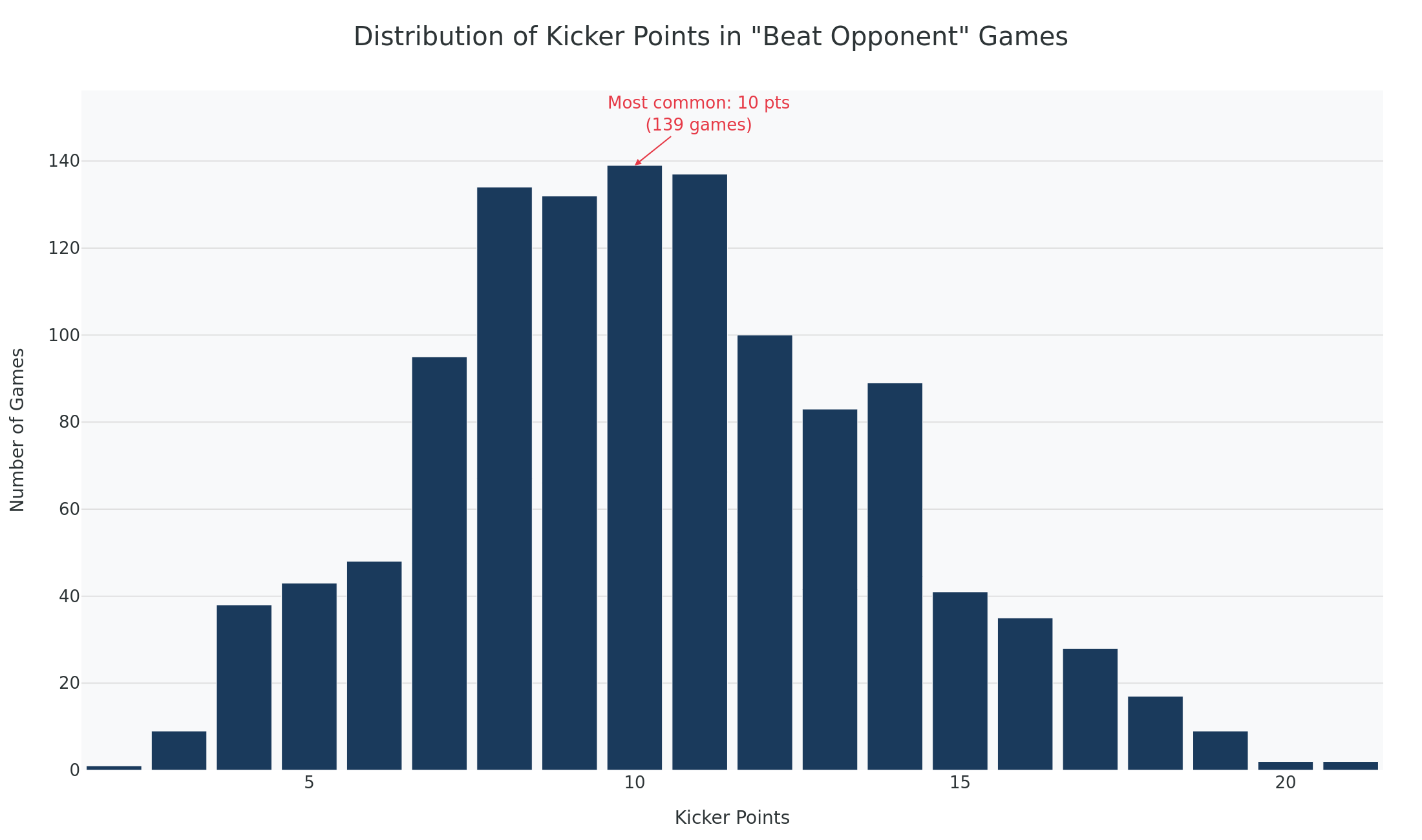
The most common point total in a “beat” game is 10 points (139 games), followed by 11 (137), 8 (134), and 9 (132). Ordinary kicking days. A few field goals, a couple of extra points. The extraordinary part isn’t what the kicker did. It’s what the opponent didn’t.
And the highest-scoring “beat” games, broken down by composition:
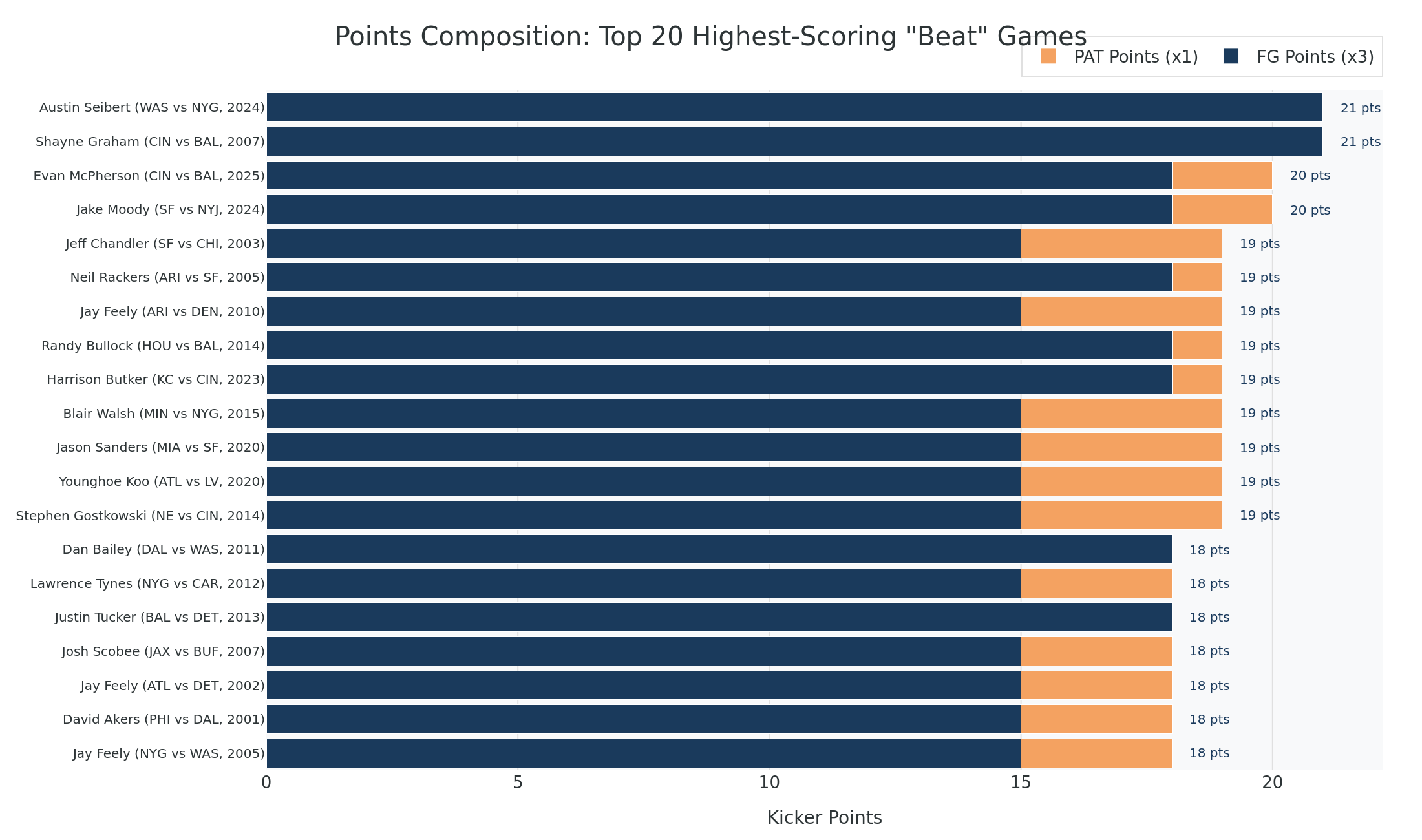
Threes and ones, stacked up. It doesn’t look like much on any single play. String them together across 60 minutes and the total becomes something else entirely.
The Carrying
In a typical NFL game, the kicker accounts for about 34% of his team’s total points.
A third of the scoring. From the guy most fans forget is on the roster. In a league obsessed with quarterback ratings and receiver yards and rushing efficiency, the guy standing off to the side with the clean jersey is responsible for a third of the scoreboard. If any other position contributed 34% of a team’s output, we’d build statues.
In “beat” games, that share jumps to 43.2%. The kicker isn’t contributing. He’s carrying.
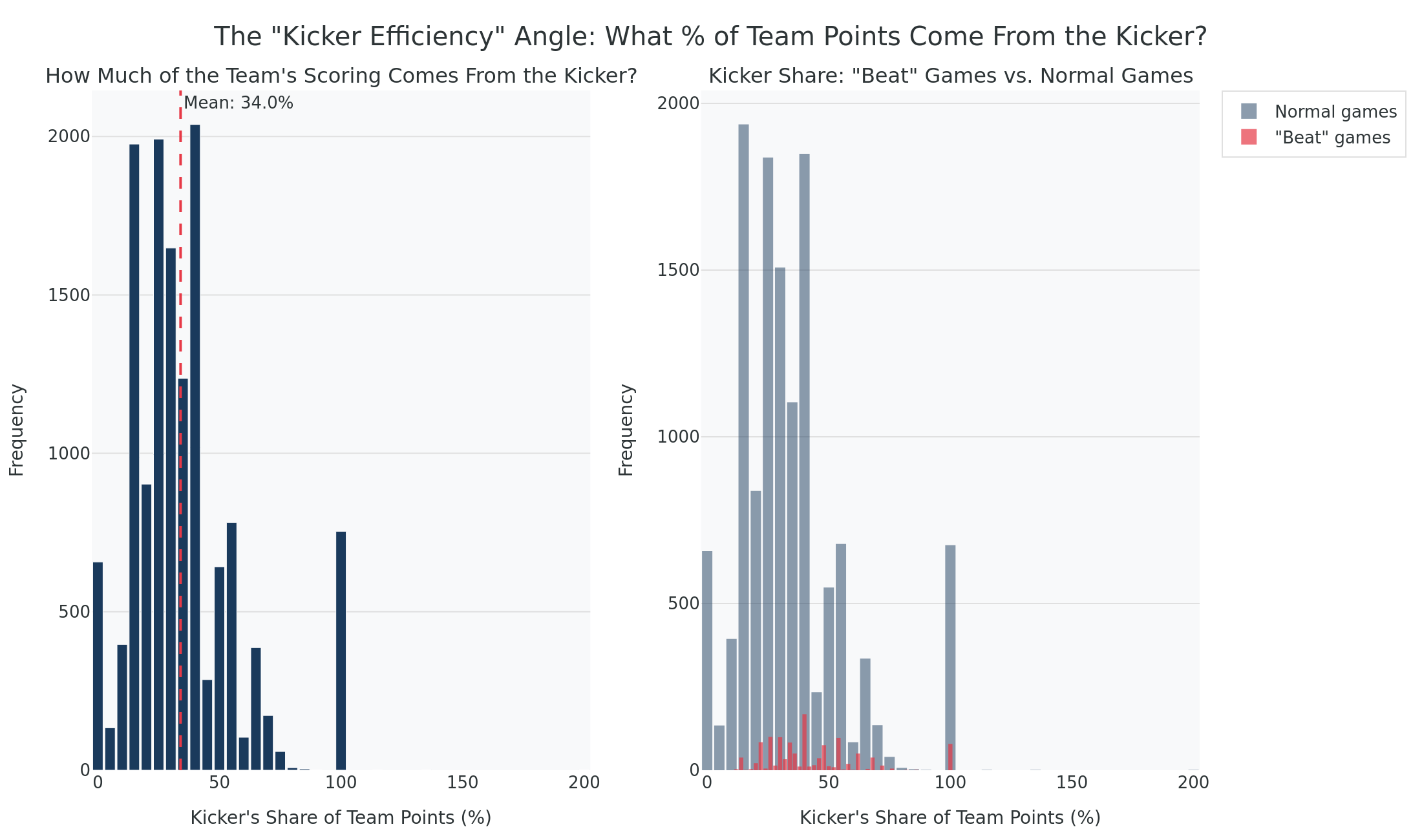
And then there’s the extreme version of this: the games where the kicker was literally the entire offense.
79 games. In 79 games across 27 seasons, the kicker scored 100% of his team’s points and still outscored the opponent. No touchdowns. No two-point conversions. Every single point on the scoreboard came from one man’s leg, and it was enough to win.
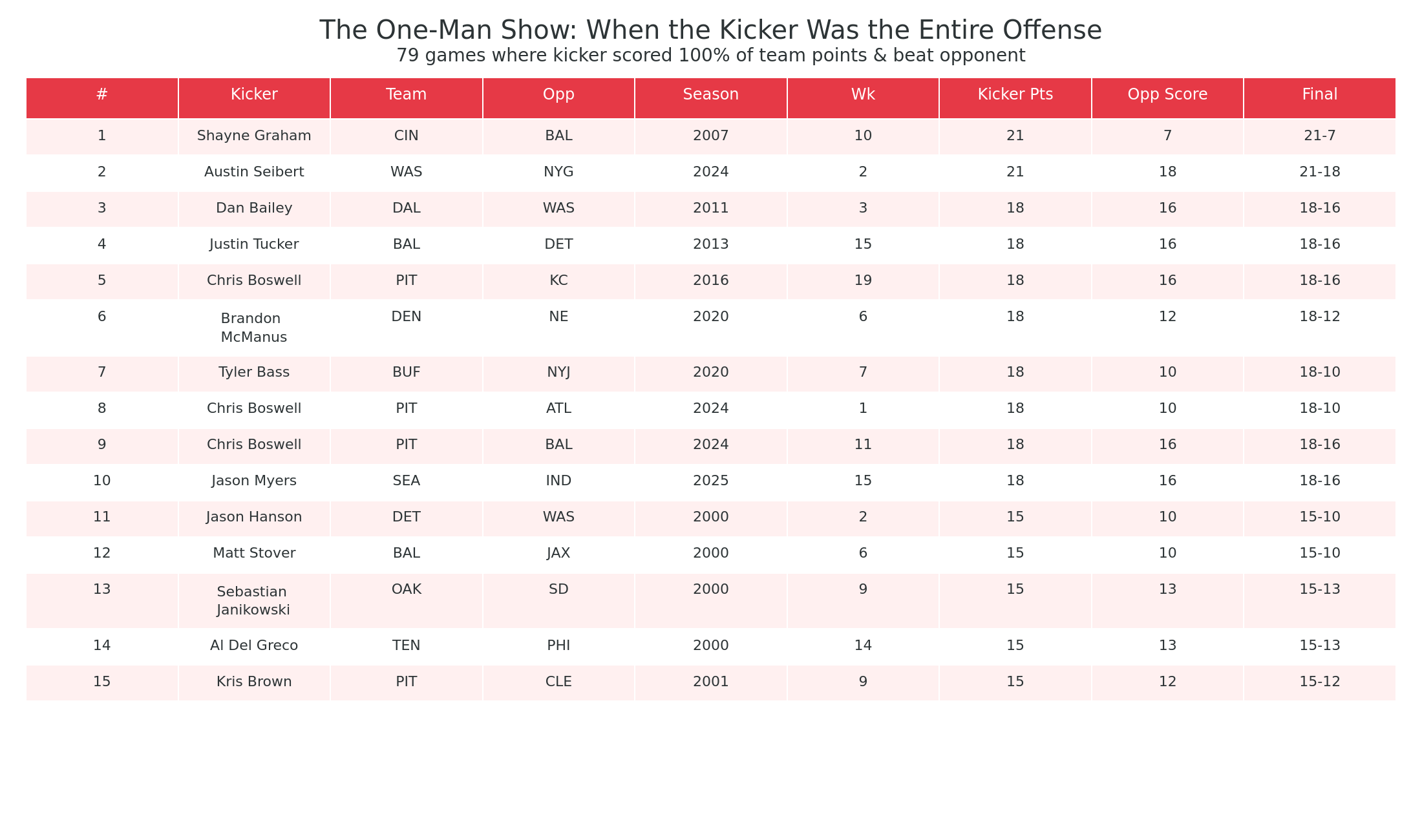
Seventy-nine times, an NFL team won a game without scoring a single touchdown. The offense drove down the field, stalled in the red zone, and handed the ball to the kicker. Over and over. And it was enough.
Chris Boswell shows up in the one-man-show records three times, including that 2017 playoff game against Kansas City. In 2024, Boswell did it twice in the same season: 18-10 against Atlanta in Week 1 (six field goals, no touchdowns) and 18-16 against Baltimore in Week 11 (again, six field goals, no touchdowns). The Steelers won two games with zero touchdowns on the strength of one man’s leg. Most of the football world barely noticed.
Austin Seibert wrote the newest chapter in 2024. Washington’s kicker went 7-for-7 on field goals against the New York Giants, scoring all 21 of Washington’s points in a 21-18 win. Seven field goals. No touchdowns. Every point from one leg. Only the second time in the dataset that a one-man-show kicker reached 21, matching Shayne Graham’s 2007 game.
These games reveal the absurdity at the heart of football’s hierarchy. An entire offense, quarterback, receivers, running backs, tight ends, five offensive linemen, collectively produced zero touchdowns. The team still won. Because the kicker showed up.
Heroes and Villains
Every “beat by a kicker” game has two sides: a kicker who dominated, and a team that couldn’t outscore a single player. Over 27 seasons, the same franchises keep showing up on the same side.
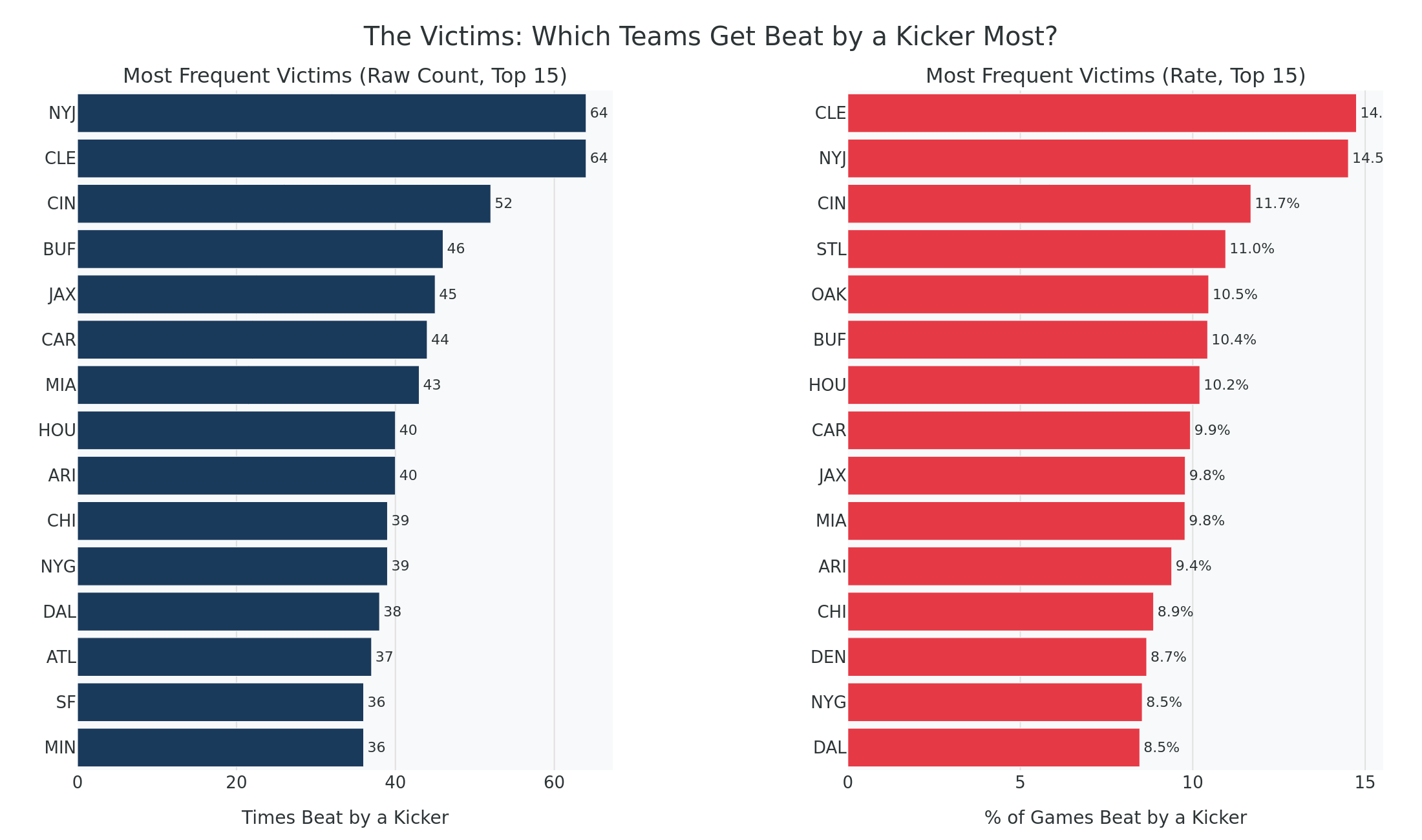
The Cleveland Browns and New York Jets are tied at the top of the victim list: 64 times each. A distinction that would be darkly funny if it weren’t so relentless.
Cleveland’s version is especially brutal. At a 14.7% rate, nearly one in seven games, the Browns have been outscored by a single opposing kicker. That’s not a bad streak or a down era. It’s an identity. The Browns have been beaten by 36 different kickers over 27 seasons. Not the same guy tormenting them. Thirty-six different men, from 36 different rosters, each individually outscoring the entire Cleveland franchise.
The tormentors are familiar faces from the AFC North: Matt Stover did it 5 times, Jeff Reed 5 times, Chris Boswell 4 times, Shayne Graham 4 times, divisional rivals twisting the knife season after season. When your division opponents’ kickers routinely outscore your entire team, the problem isn’t the kicker. It’s everything else.
The Jets’ 64 appearances are equally painful. The Bengals (52), Bills (46), Jaguars (45), and Panthers (44) round out the top of the victim list, a group of franchises that have spent large portions of the last three decades struggling to field competent offenses.
The other side:
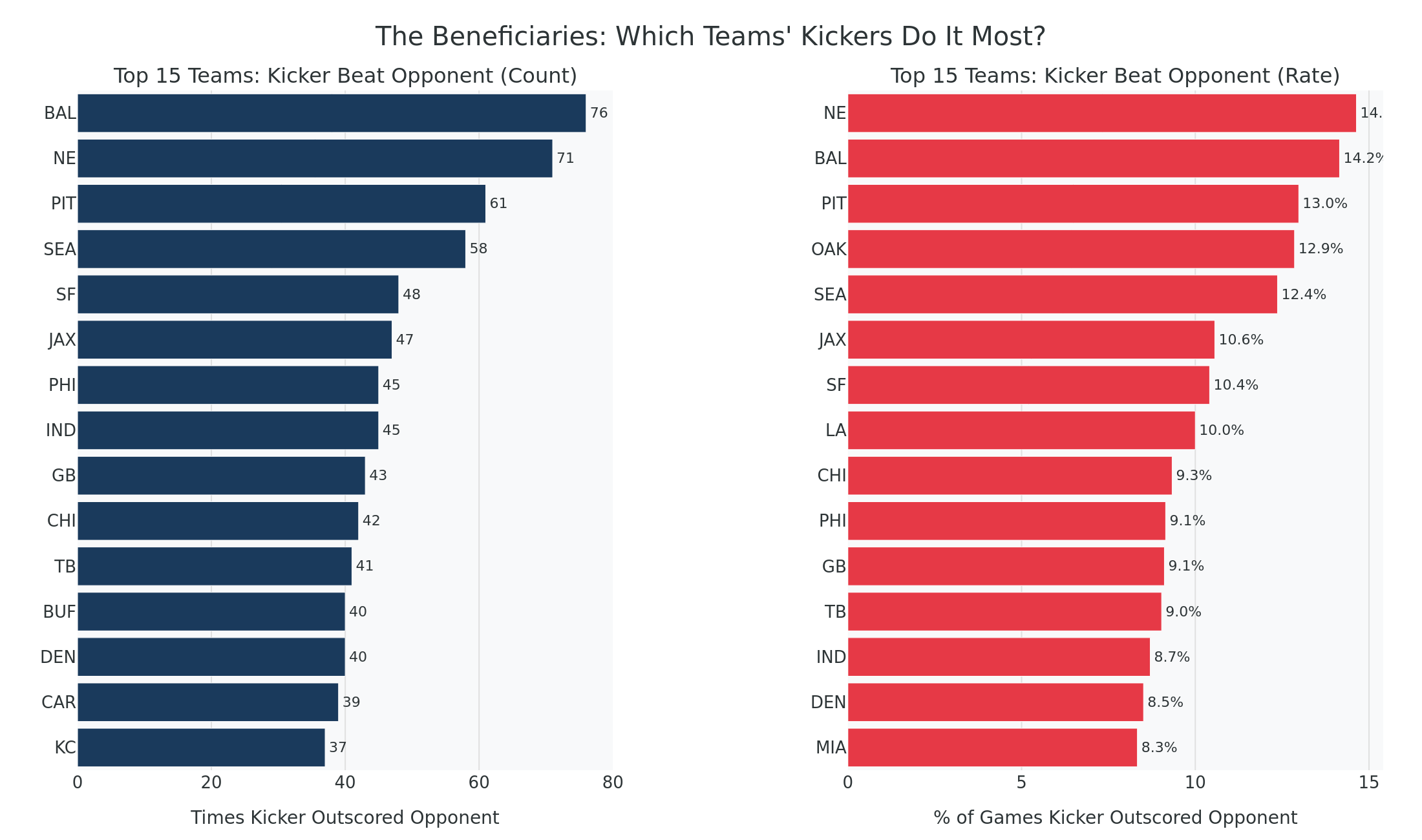
The Baltimore Ravens lead the beneficiary list at 76 games, and the reason is a perfect marriage of elite kicking and elite defense. Matt Stover, then Justin Tucker. And a defense that, for most of the last 27 years, has been among the best in football. When your defense holds opponents to 10 points and your kicker puts up 11, the kicker gets the statistical credit. But the defense created the conditions for it.
The New England Patriots (71 games, 14.6% rate) are the same story: Vinatieri and Gostkowski kicking behind the Belichick defense. The Pittsburgh Steelers (61) had Jeff Reed and Chris Boswell backed by decades of strong defensive football. Seattle (58) benefited from the Legion of Boom era and the reliable legs of Steven Hauschka and Jason Myers.
The through line is obvious. A “beat by a kicker” game requires more than kicking. It requires a defense that holds opponents down. The kicker provides the points. The defense makes those points sufficient. Both are necessary, but the kicker gets the credit line.
The Landscape
Zoom all the way out. Every game in the dataset becomes a single point: kicker’s points on one axis, the opponent’s score on the other. The diagonal line is the tipping point. Below it, the kicker wins; above it, the opponent does.
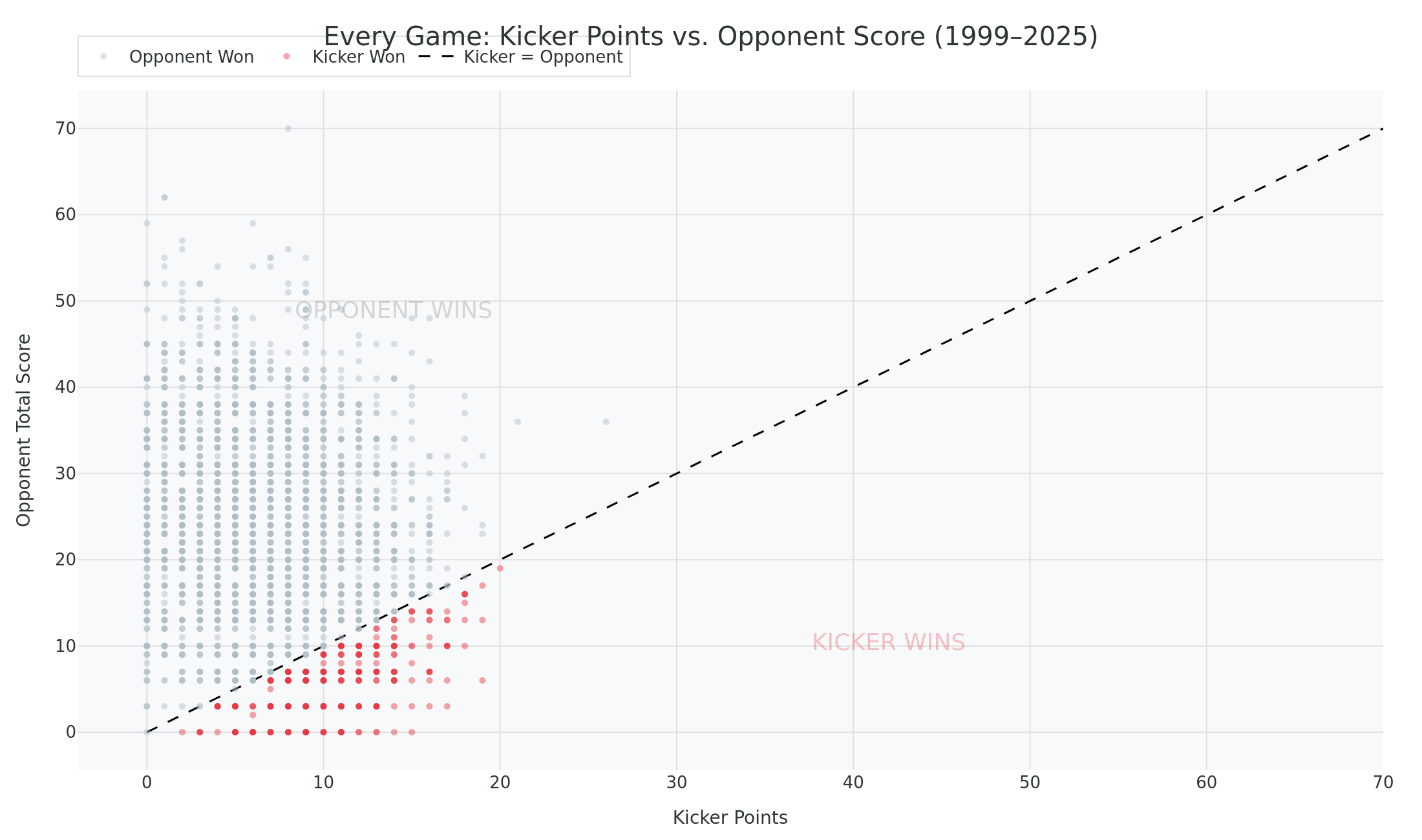
Fourteen thousand data points, scattered across a grid of possibilities. The “beat” zone, below and to the right of the diagonal, is sparsely populated but real. A thin layer of red dots where one player outperformed an entire team. They cluster where kickers score 6-15 points against opponents held to 0-10. But they stretch further than you’d expect, reaching into territory where kickers put up 15, 18, even 21 points against opponents who scored real points.
The same data, viewed as density:
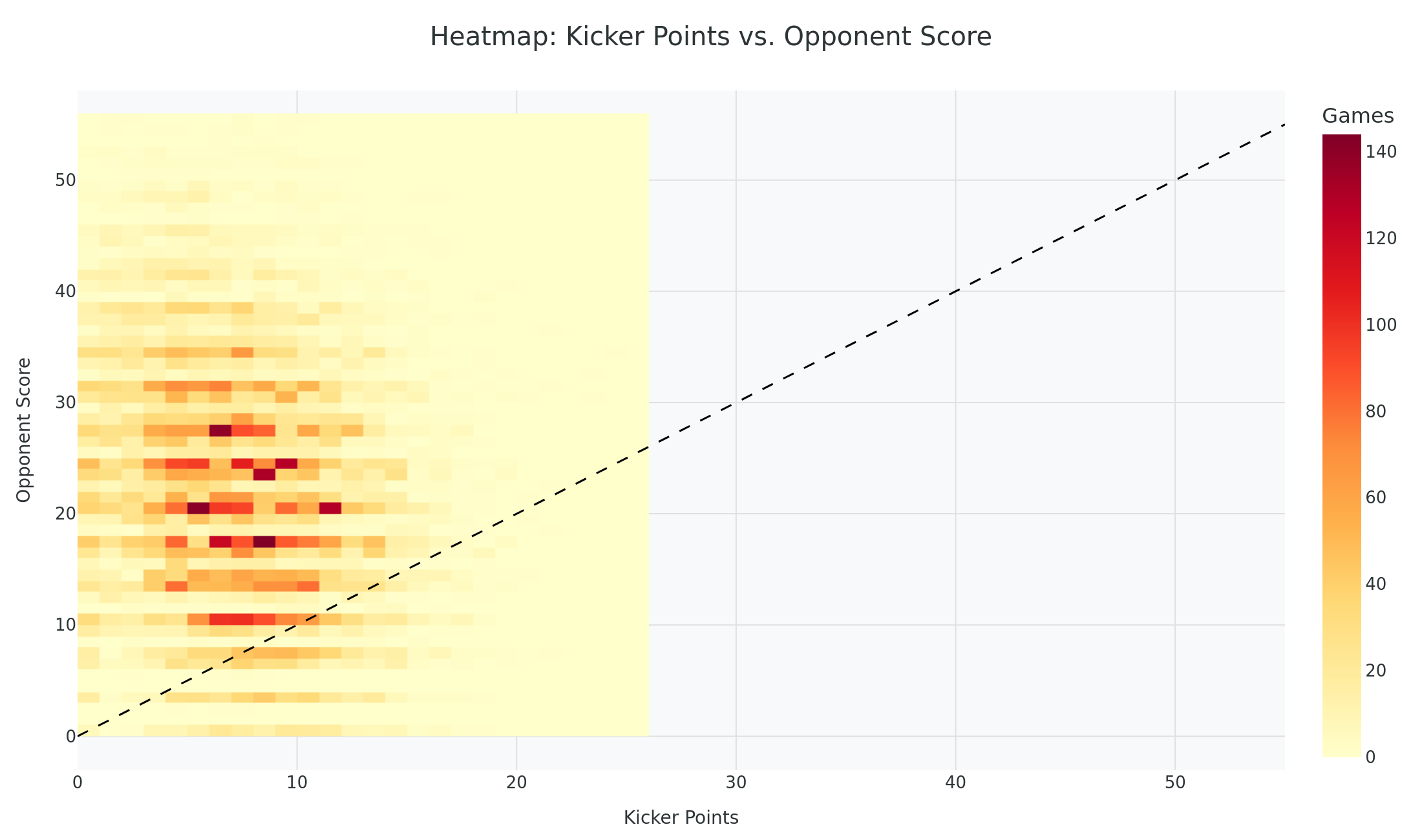
The densest region sits where kickers score 3-9 points and opponents score 14-28, the typical NFL game. The “beat” zone glows faintly in the lower-right corner. Rare, but persistent. Twenty-seven years of offensive evolution haven’t stamped it out.
Drilling into the specific score combinations that occur most often in “beat” games:
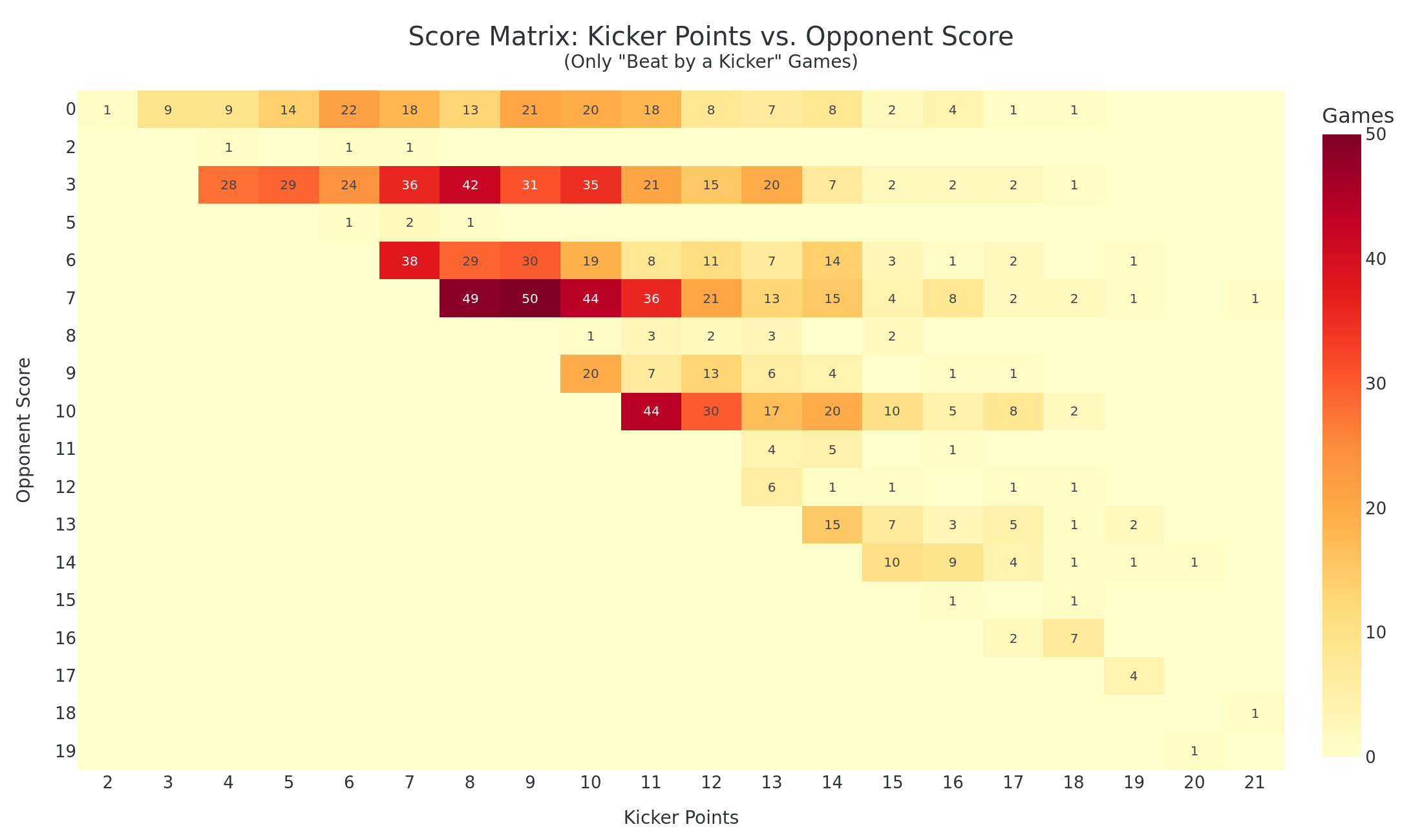
The most common scenario: a kicker puts up 9-10 points against a team that scored 3-7. These aren’t shutouts. The opponent scored. They drove down the field, converted third downs, ran real plays. They just couldn’t outscore one man.
Context Is Everything
Does it matter where the game is played? When in the season? How high the stakes are?
Home vs. Away: Home kickers are 66% more likely to outscore the opponent.
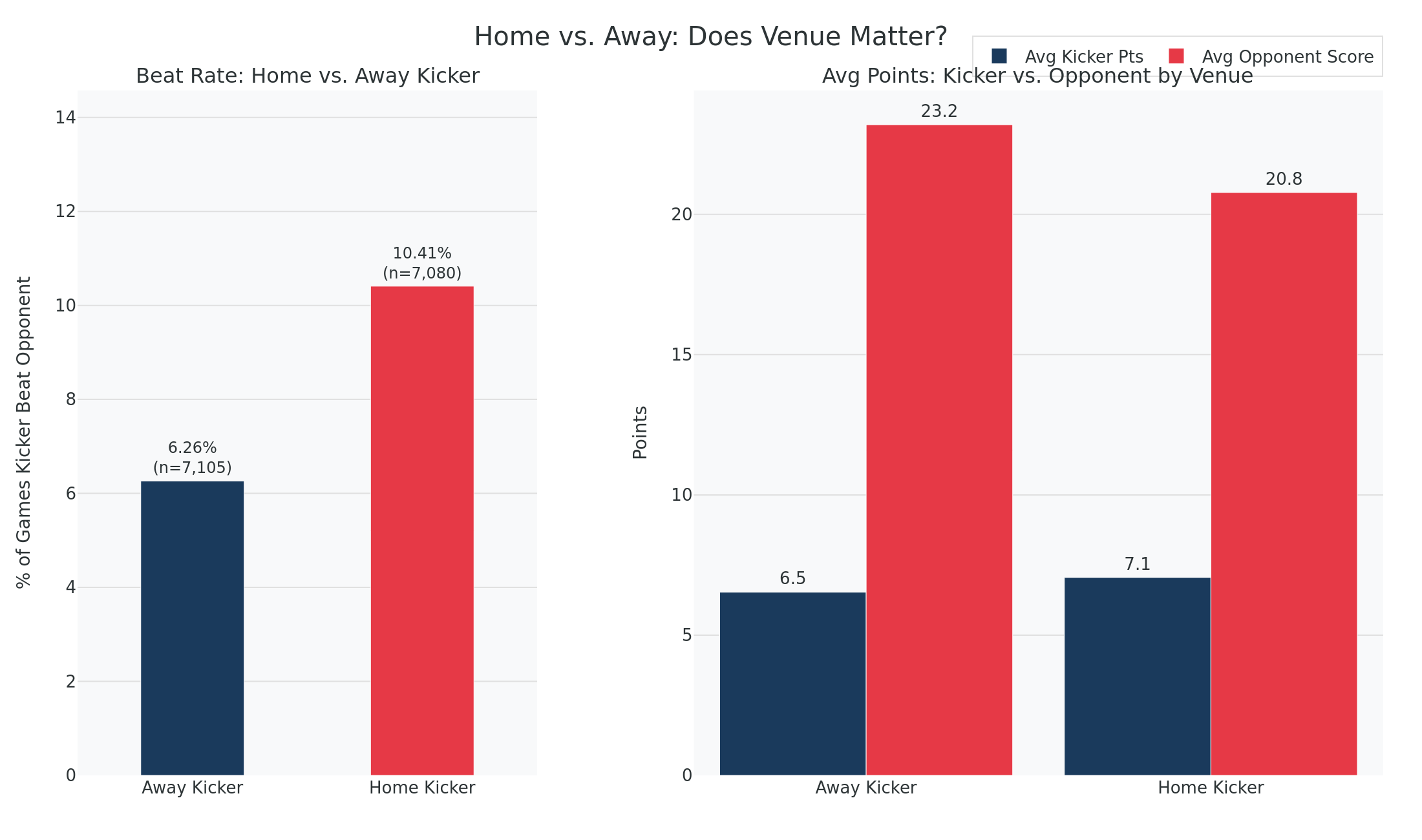
Home kickers outscore opponents at a 10.4% rate versus 6.3% on the road. Home teams score more in general, their defenses allow fewer points, the crowd disrupts opposing offenses. And yes, the kicker knows his own field. He’s practiced on that surface hundreds of times. He knows how the wind swirls in the fourth quarter. In a position where inches matter, familiarity counts.
Climate control: This one was counterintuitive.
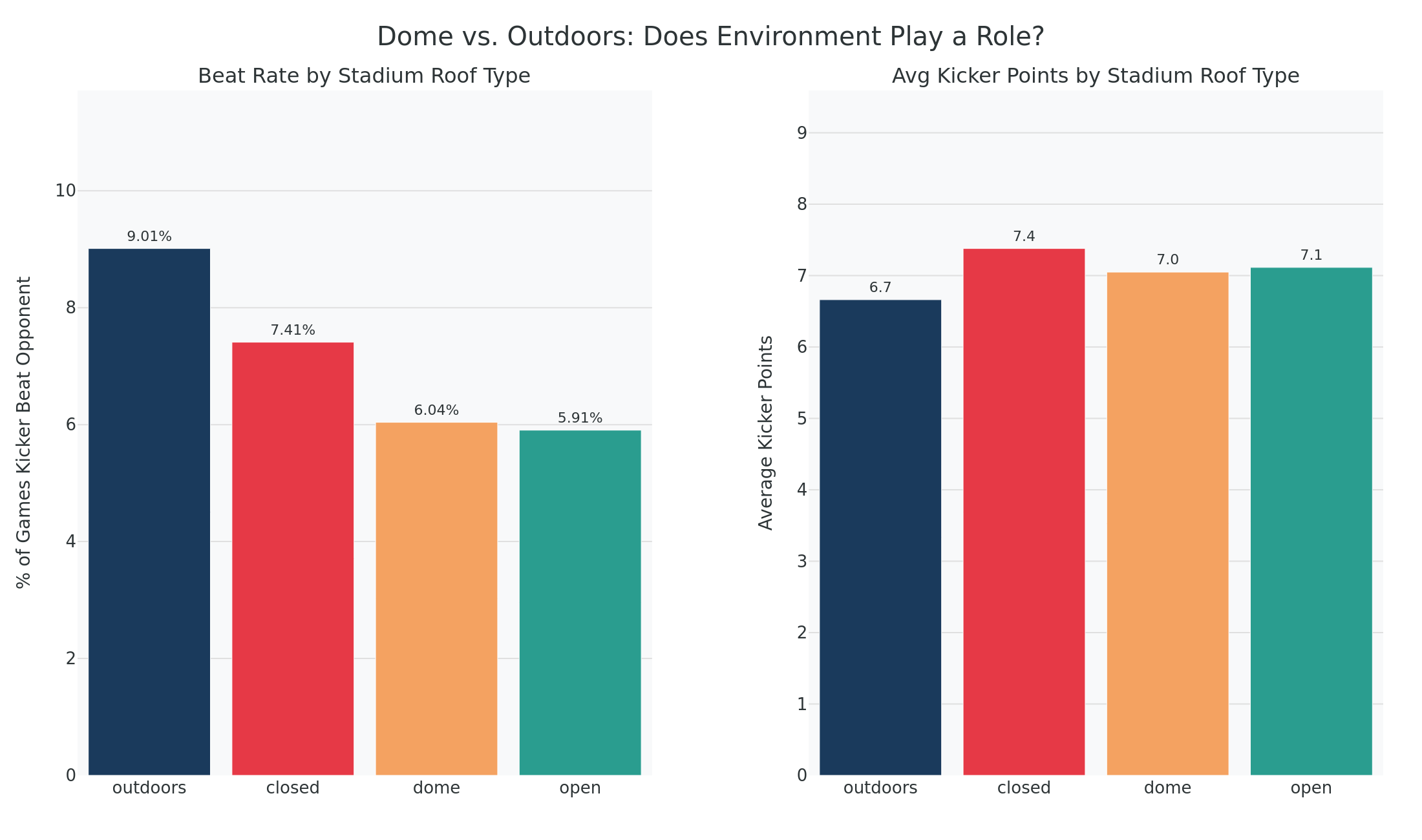
You’d think dome stadiums, no wind, no rain, no frozen turf, would be kicker paradise. Kickers do score more indoors (averaging 7.0-7.4 points versus 6.7 outdoors). But the beat rate is actually higher outdoors (9.0% versus 6.0-7.4% in domes). The reason makes sense once you think about it: the same conditions that challenge kickers wreck offenses even harder. Wind doesn’t just affect field goals. It disrupts passing games, causes fumbles, turns routine plays into chaos. Bad weather is a kicker’s friend, not because it helps him kick, but because it hurts everyone else more.
The playoffs: Things change when the stakes go up.
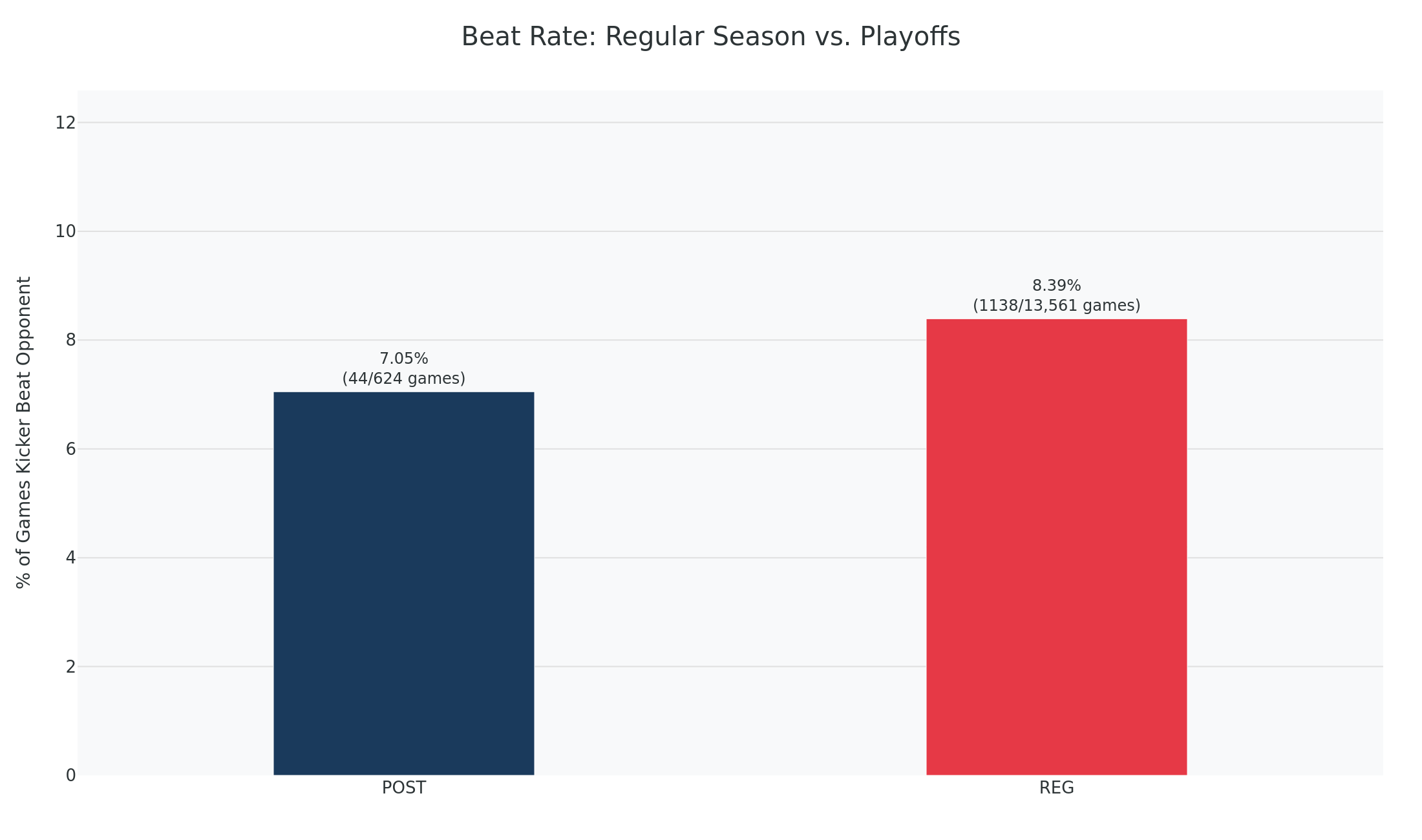
Regular season games produce “beat by a kicker” results at an 8.4% rate. The playoffs drop to 7.1%. Playoff teams are, by definition, the league’s best. Their offenses are more potent. Their defenses are more disciplined. They rarely get held to single-digit scores. Being outscored by one kicker in the playoffs is uncommon, but it still happened 44 times in this dataset. Forty-four playoff teams went home having failed, among other things, to outscore a single specialist.
Overtime nearly erases the phenomenon entirely.
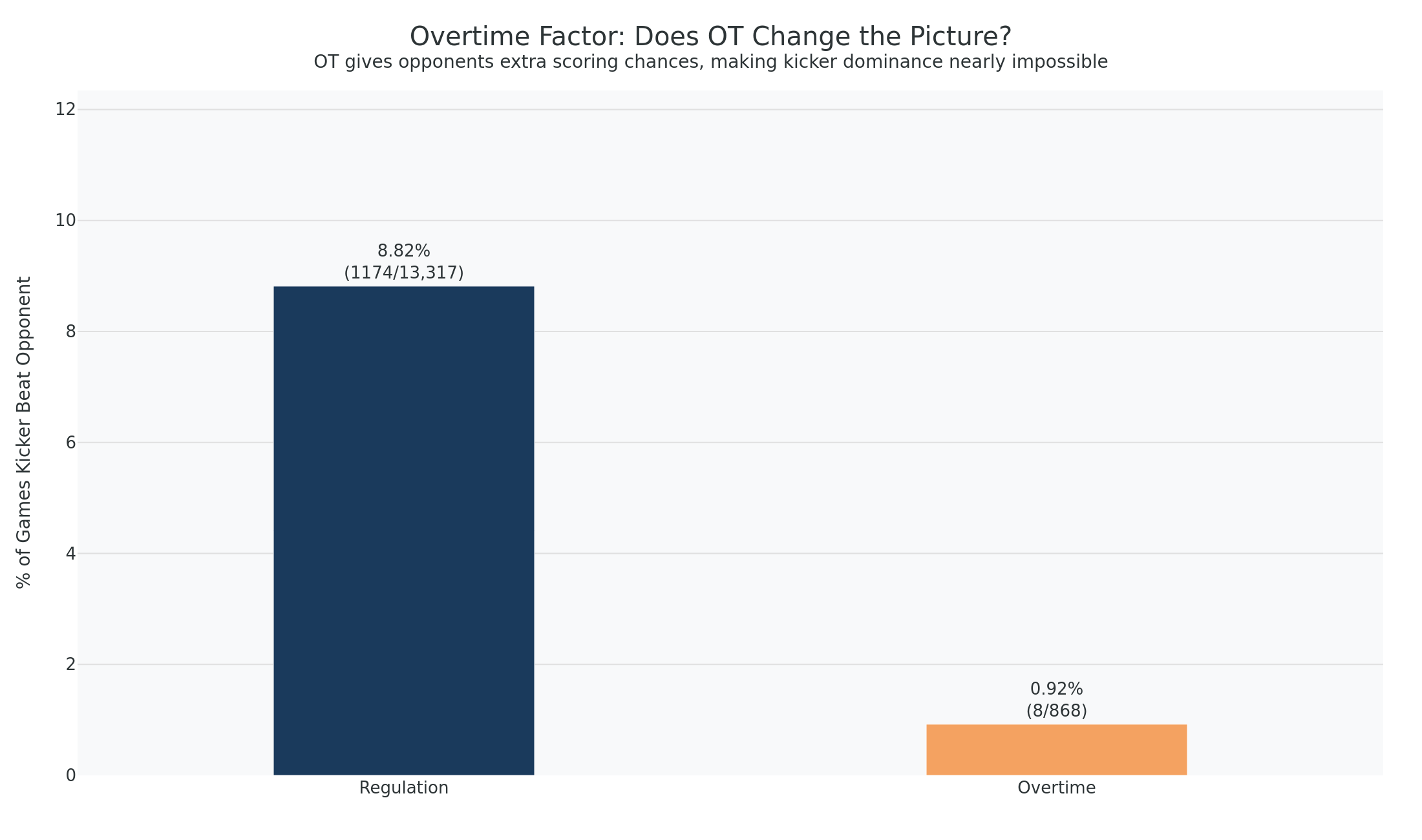
Only 0.92% of overtime games, 8 out of 868, ended with a kicker outscoring the opponent. The extra period gives the trailing team more possessions, more chances, more time to put up points. Overtime levels the playing field against one-man dominance.
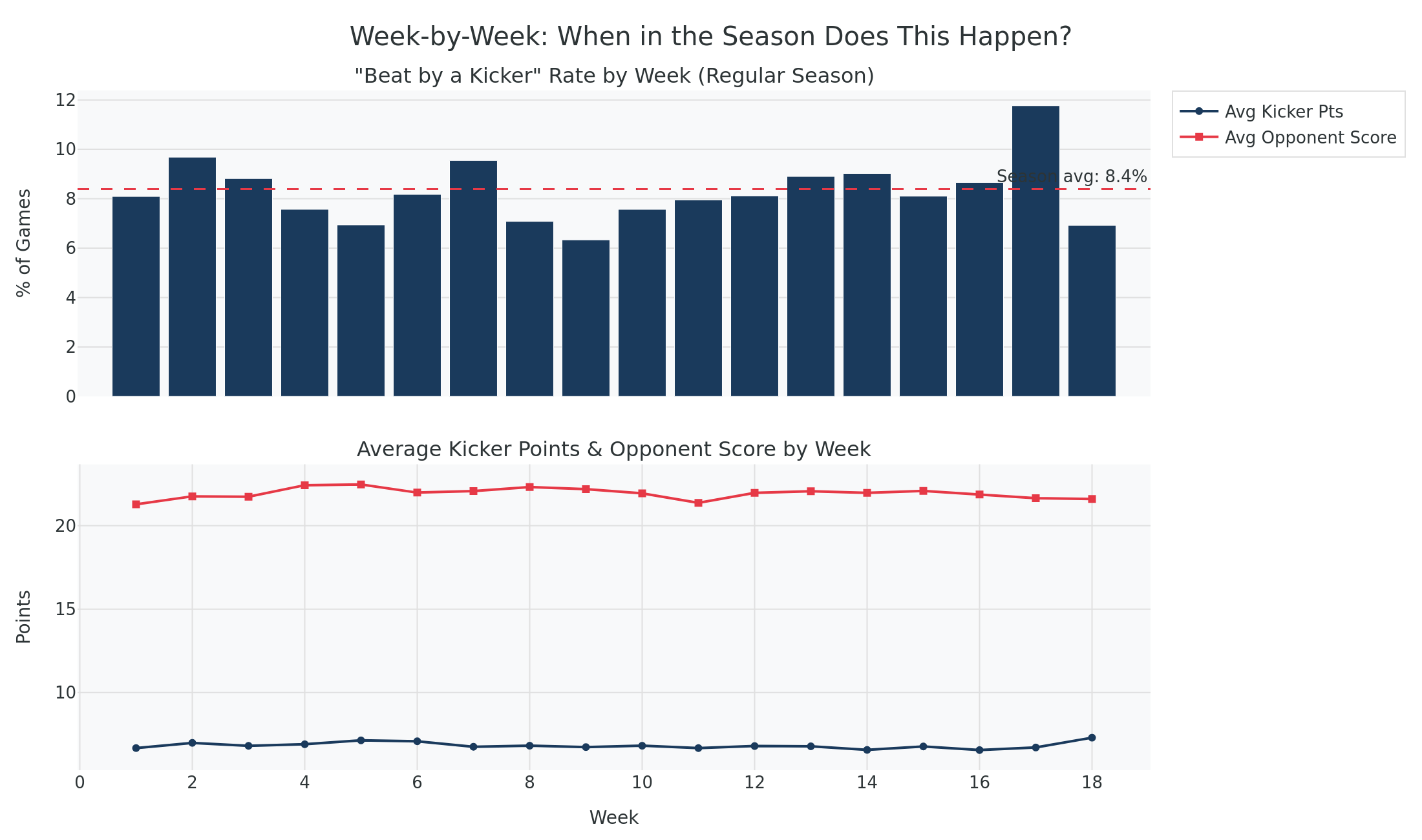
The weekly rhythm shows some variation but no dramatic trend. Whether it’s opening day or the stretch run, kickers are equally capable of outscoring opponents. The phenomenon isn’t seasonal. It shows up all year.
How Low Do They Go?
When a team gets “beat by a kicker,” what does their scoreboard actually look like?
About 15% of these games are shutouts, the opponent scored zero, making even a single field goal enough. But the other 85% involved opponents who put up real points and still couldn’t outscore one kicker.
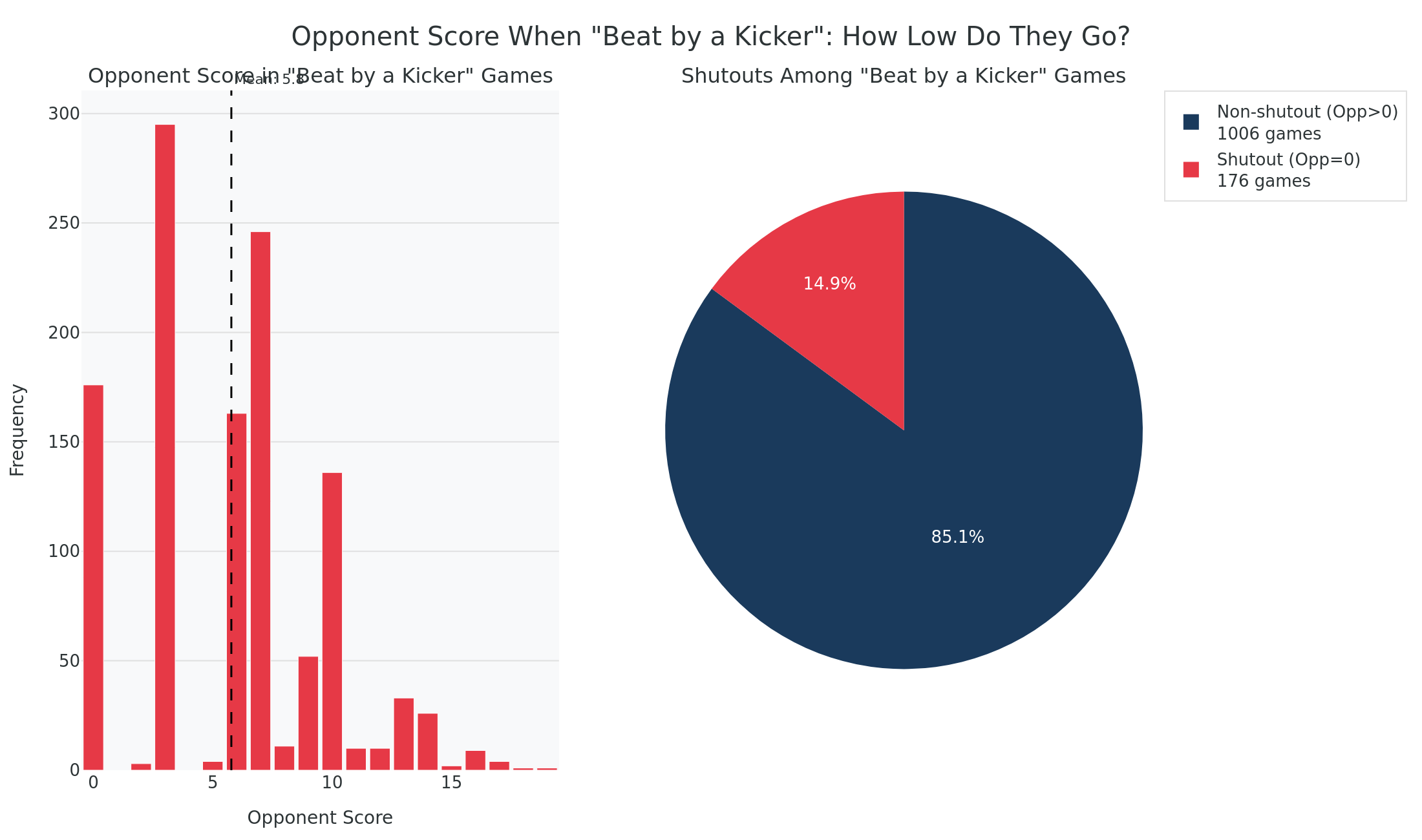
That 85% matters. In the majority of “beat by a kicker” games, the losing team scored 3, 6, 7, even 10 points. They moved the football. They got into the end zone, sometimes more than once. They played a real football game. It just wasn’t enough to outscore one man.
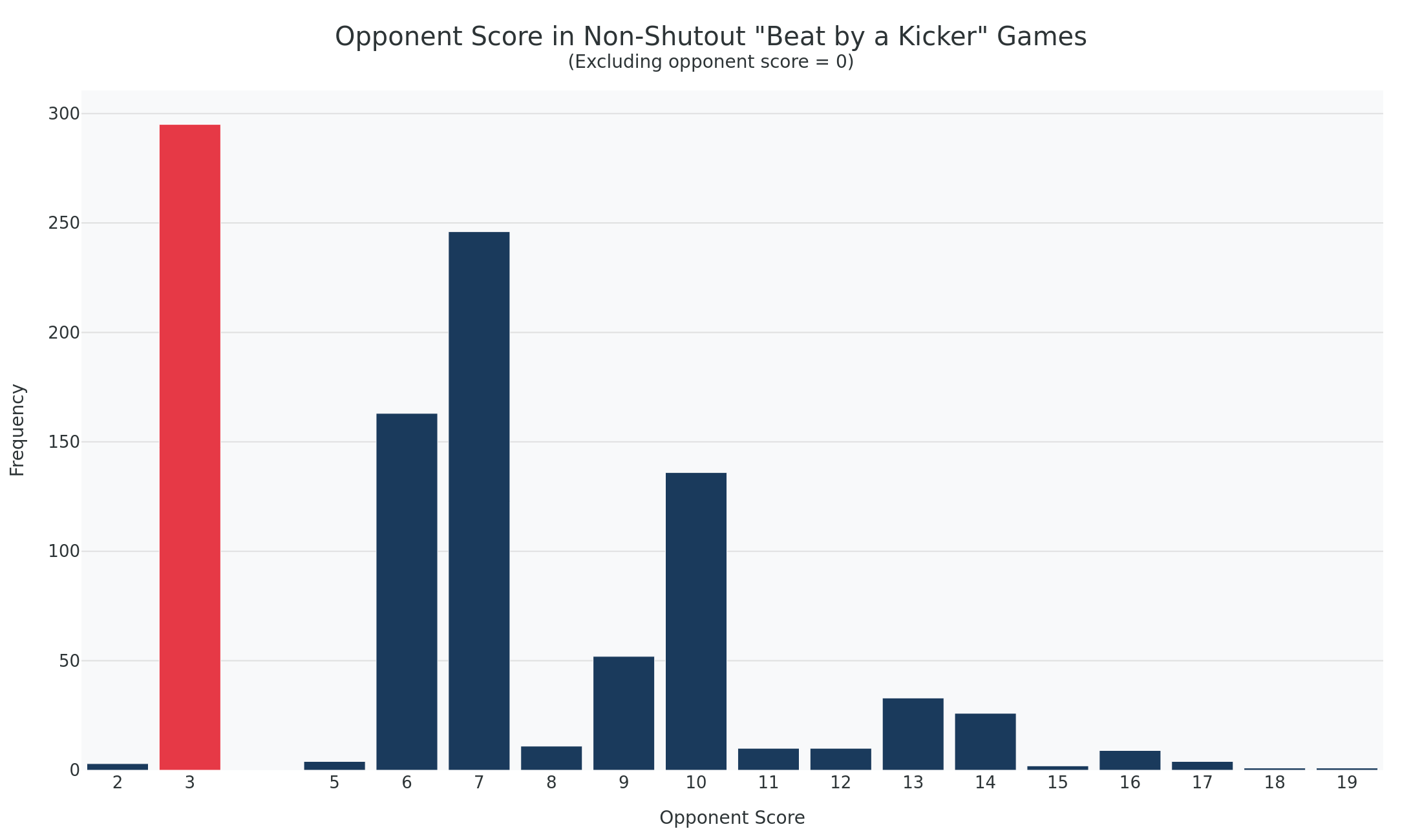
The most common opponent score in a non-shutout “beat” game is 3 points, a team that managed a single field goal and nothing else, beaten by a kicker who hit a few of his own. But scores of 6, 7, and even 10 show up regularly. There are games in this dataset where a team scored 10 points, a touchdown and a field goal, a perfectly respectable half of football, and still lost to a kicker who happened to score 11.
Close Calls
Not every “beat” game is a blowout. And not every close call becomes a “beat.”
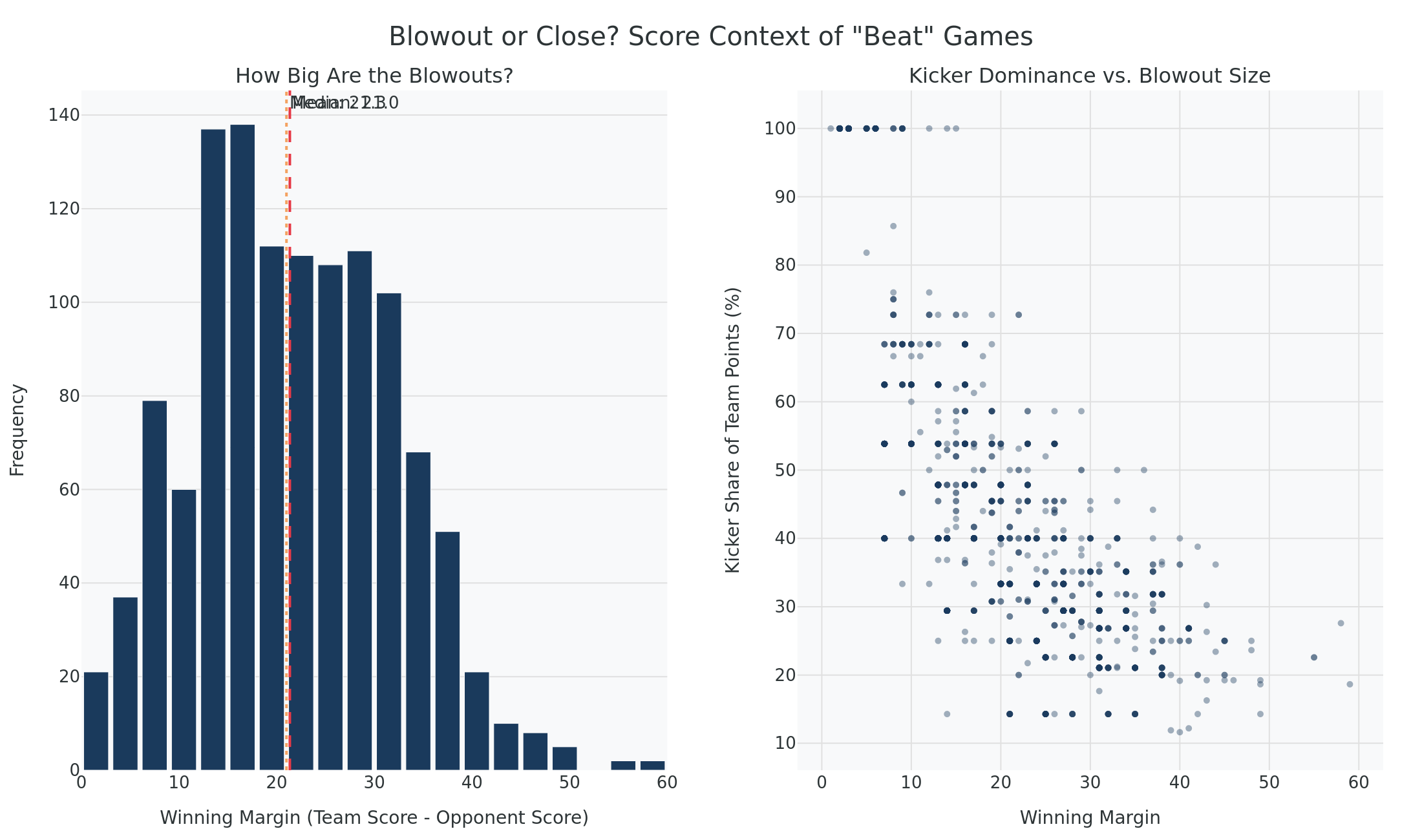
While the median margin is large, the edges of the distribution tell a different story: games where the kicker barely outscored the opponent, where one missed field goal or one extra opposing first down would have changed the math entirely.
Then there’s the Almost Club, games where the kicker came agonizingly close to outscoring the opponent but fell just short:
- 228 games: 1 point short
- 277 games: 2 points short
- 387 games: 3 points short
That’s 892 near-misses across 27 seasons. One more field goal, one fewer opponent touchdown, and the list of “beat by a kicker” games would be dramatically longer.
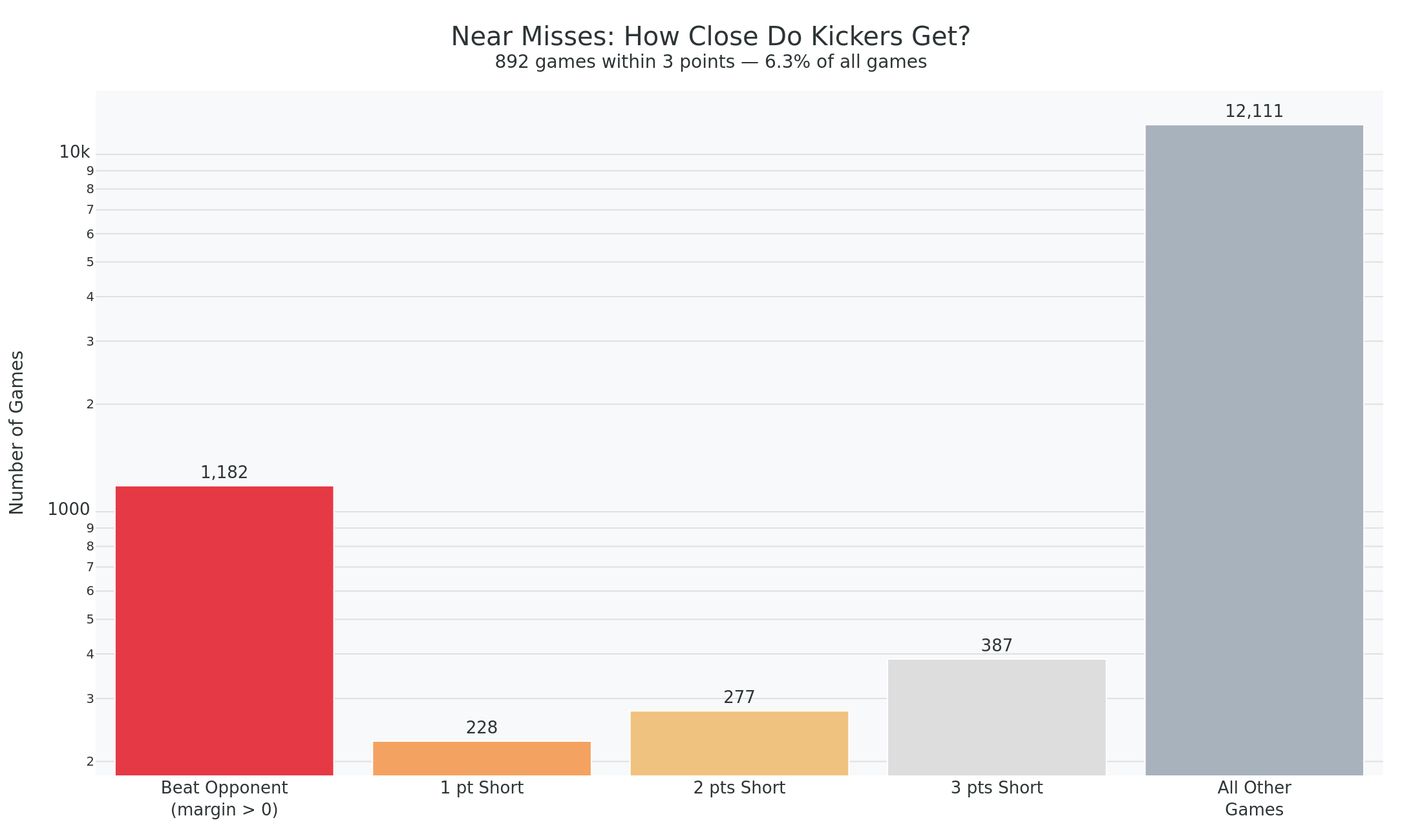
The 1-point-short category is the one that stings. 228 games where the kicker was one extra point, one automatic, routine, barely-worth-watching kick, away from outscoring the entire opposing team. In one of those near-misses, Jason Sanders of Miami scored 21 points against the Jets in 2019, but the Jets scored 22. One point. Twenty-one points from a single kicker and it still wasn’t enough.
Combine the actual beats (1,182) with the near-misses within 3 points (892) and you get 2,074 games, nearly 15% of all games, where a kicker was within striking distance of outscoring the entire opponent. One in seven. The phenomenon has a long shadow.
The Magic Number
So what kicker point total guarantees you’ll outscore the opponent?
There isn’t one.
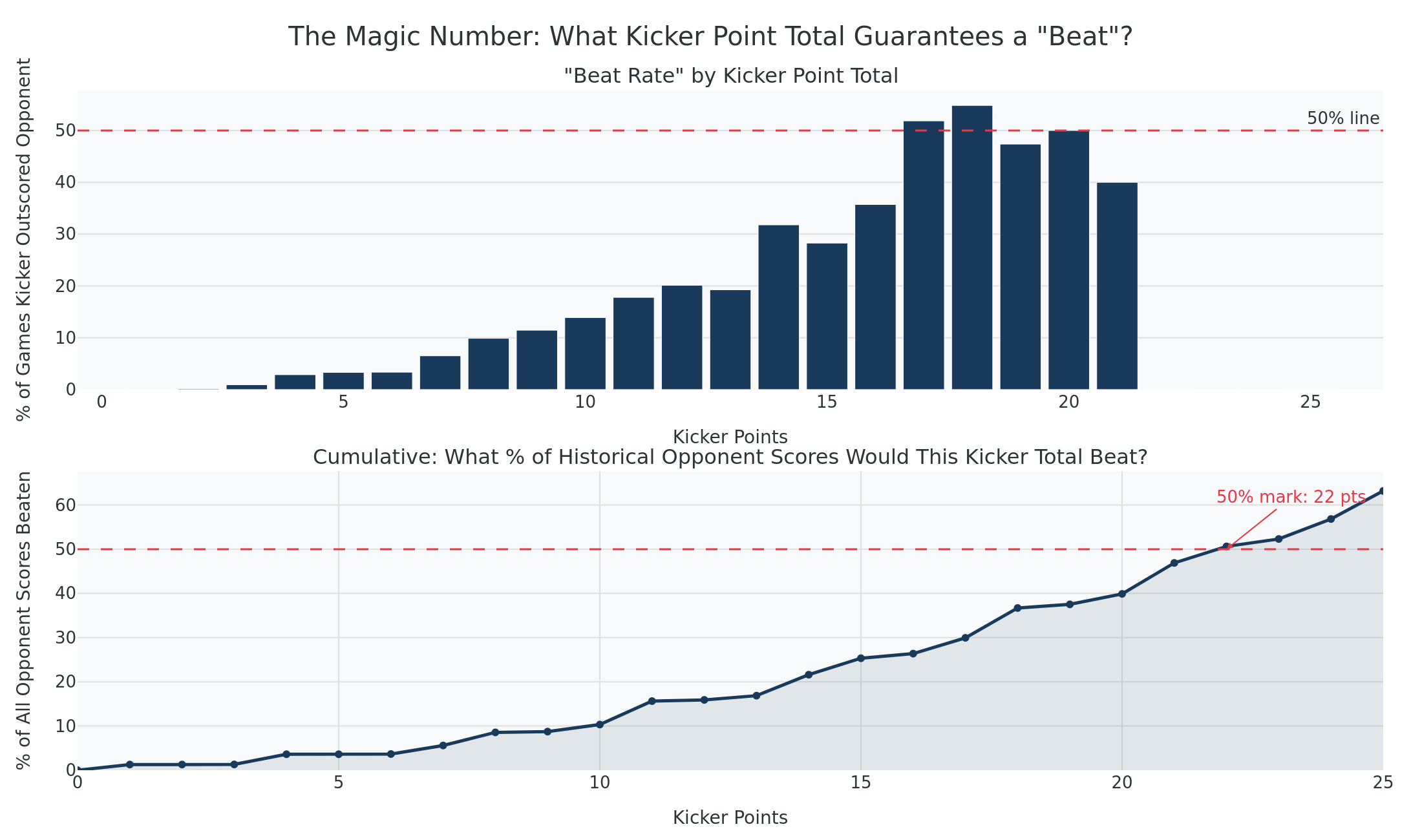
At around 17 kicker points, you’ve historically beaten the opponent more than half the time. But even at 20+, some opponents scored more. A kicker can put up 20 points and still lose to an offense that found another gear in the fourth quarter. The NFL doesn’t do guarantees.
That’s what makes the 1,182 times a kicker did outscore the opponent all the more striking. No certainties. Just accumulation, reliability, and the hope that today is one of those days.
The Evolution
Football has changed a lot across this 27-year window. The 1999 game, ground-heavy, defense-dominant, low-scoring, barely resembles the aerial fireworks of the 2020s. The phenomenon evolved with it:
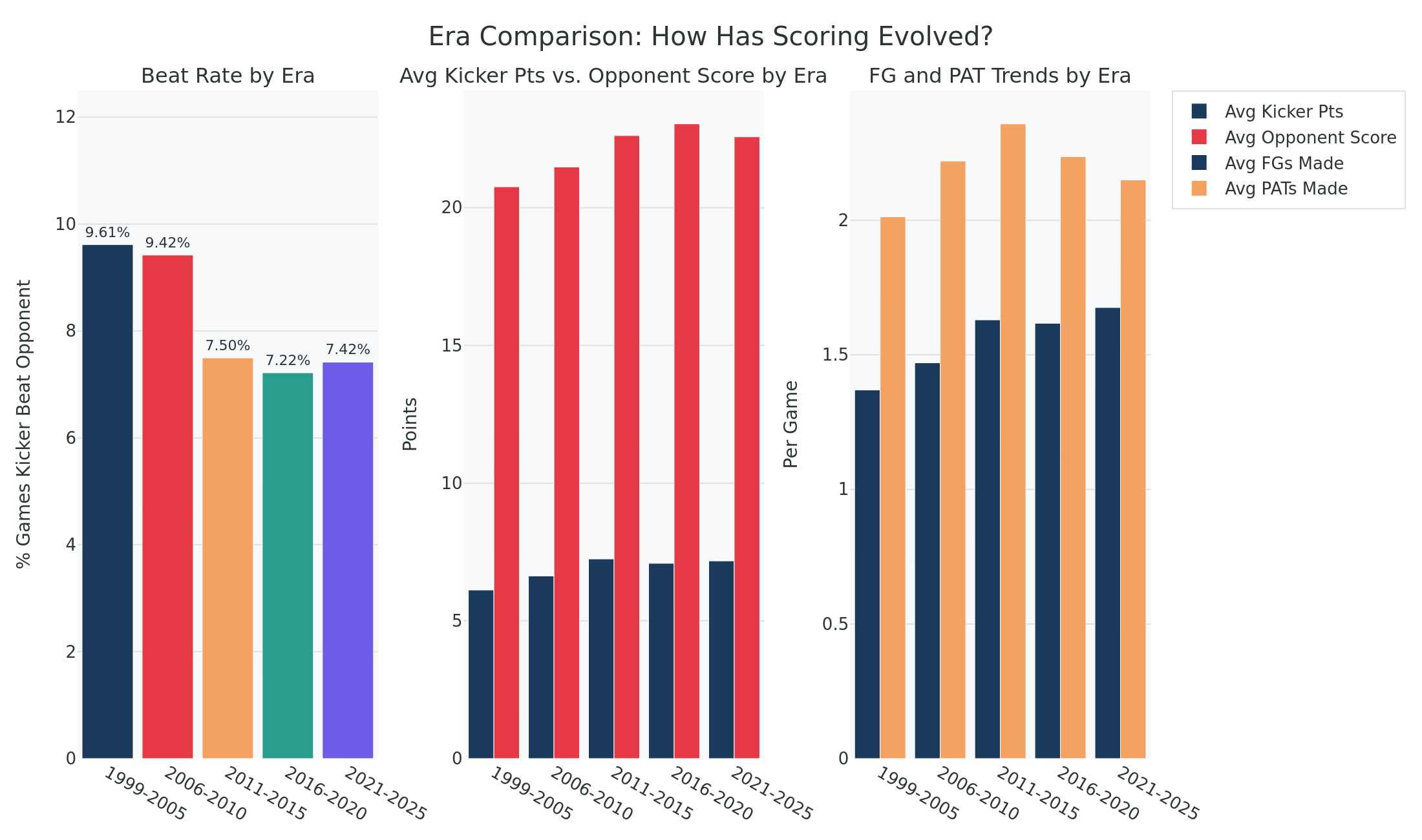
The decline is real but gradual. The 1999-2005 era saw the highest “beat” rate at 9.6%, when average opponent scores sat around 20.8. By 2021-2025, opponents averaged 22.6 points and the beat rate settled to 7.4%.
The telling detail: kicker points per game actually rose over the same period, from 6.1 in 1999-2005 to 7.2 in 2021-2025. Kickers got better. They score more, attempt more, and convert at higher rates than their predecessors. The beat rate declined not because kickers got worse, but because offenses improved faster. The gap between one kicker’s output and one team’s output widened, and the kicker, despite personal improvement, couldn’t keep pace with the offensive explosion happening around him.
There’s something bittersweet about it. Kickers have literally never been better at their jobs. The game around them has never noticed less.
The Full Picture
Epilogue: One Man, One Leg
This started as a stat. A weird number I stumbled across and couldn’t stop thinking about.
In 1,182 games across 27 seasons, a single kicker, the position most frequently dismissed as “not real football,” produced more points than an entire opposing roster of 53 men. Every single time it happened, the opponent lost. No exceptions in 27 years.
Adam Vinatieri did it 40 times, from the Belichick dynasty to the Manning-era Colts. Matt Stover did it at a rate of nearly one in five, riding the Ravens defense to statistical territory no kicker has matched. Chris Boswell did it in a playoff game, winning with nothing but field goals while the Steelers offense failed to find the end zone even once. Shayne Graham did it with seven field goals and zero touchdowns, building an entire victory three points at a time.
These aren’t flukes. They’re the product of accuracy under pressure and consistency across decades, the work of athletes who rarely get the credit they deserve.
But this story is about more than individual performances. It’s about what shows up when you look at the NFL from an angle nobody usually bothers with. Stop watching the quarterback and the receivers and the running backs, the players who get the magazine covers and the shoe deals and the hall of fame speeches. Look instead at the guy standing off to the side, helmet in hand, waiting for his moment.
That guy accounts for a third of his team’s points in a typical game. In his best games, he accounts for all of them. And roughly once every twelve games across 27 years of NFL history, he alone scored more than an entire opposing franchise could manage.
The NFL worships spectacle. Kickers don’t offer spectacle. They offer reliability and precision, the boring, repetitive, unglamorous accumulation of threes and ones, week after week, year after year, until the total adds up to something nobody expected.
Seventy-nine times, an NFL team won a game where every single point came from the kicker. No touchdowns at all. Just one man, doing the thing he’s done ten thousand times in practice, with the game on the line.
Kickers don’t throw touchdown passes. They don’t make diving catches. They don’t deliver bone-crushing hits. But more often than you’d believe, they outscore entire teams. They carry franchises. They win playoff games without a single touchdown. They account for a third of every team’s points while the rest of the sport pretends they don’t exist.
They’re not just “the kicker.”
They’re people too. And they might be the most undervalued athletes in professional sports.
Data: nflreadpy (1999-2025) | Analysis: Python, Pandas, Plotly | 14,185 kicker-game records analyzed across 27 NFL seasons